The following post is about ambivalence and remembrance. It is comprised of unstructured vignettes, loosely tied with my thoughts on identity, family, and cultural legacy. These thoughts were inspired by the fact that today is April 24, and we are 100 years removed from the beginnings of the Armenian Genocide.
I am not an authority on the Armenian Genocide. I can only speak from my perspective as a fourth-generation descendant of someone who lived through it. There are numerous scholarly, pop, and fiction texts on the subject, as well as recent media coverage of the history and current issues surrounding remembrance. I encourage you to read widely.
Here we are.
A century removed from the dawn of a genocide that massacred individuals, stolen family legacies, and endangered an entire culture.
Here we are. Here. Now.
We are.
We are, still.
The nation-state of Turkey does not publicly refer to the atrocities the Ottoman Empire committed against its Armenian citizens as genocide. It is public knowledge that this is a HUGE bone of contention for many Armenians & Armenian-Americans, and a sticking point in geopolitics. You may have read about it or heard about it in recent days on the news. I am glad this is getting media attention.
But I have come to realize that I don’t need a government to legitimize my great-grandmother’s lived experience and its continued effects on our family. That being said, I respect that many do need this, and I understand why they do. Recognition, admission of ancestral wrongdoing, is critical to healing. It gives a lot of power over the truth to governments, but that is the world we live in.

I read this in English, obviously.
The thing that struck me about The Bastard of Istanbul (a novel whose disturbing reveal you can, to your mounting horror, see coming a mile of alternating-perspective chapters away) is that some modern-day citizens of Turkey might not know about this part of Ottoman-Armenian history, and thus have no simmering feelings or opinions about it. In this particular novel, when Turkish characters hear the story of an Armenian character’s ancestors, they are horrified and sympathetic. But this is the first they are hearing about what was a systematic eradication of an ethnic/cultural group.
Their ignorance shrouds truth. Their ignorance leaves no place for Turkish denial, for Armenian insistence, for indigence or entrenchment on either side. This ignorance is the fault of the state, not the individual. So it is the nation-state, not its people, that become the important players in the geopolitical and ethnic and cultural narrative. This politico-narrative reality is why so many Armenian-Americans are disappointed–if not angry–with President Obama, and thrilled with Pope Francis.
The Brand Library in Glendale has been hosting events, exhibitions, conversations, film screenings, for months now to mark the 100th year of survival. Several times I have been compelled enough, felt enough of a sense of duty, to put these in my calendar. Each time I did not go.
What is it that keeps me from participating? Keeps me from showing up?
Part of it is my dwindling ties to my Armenian heritage, and by extension any entree into the Armenian community. I feel embarrassed at the prospect of going up to someone who seems to embody and/or perform the authenticity I lack and claiming ancestry. They would know I was a phony. And yet, what is authenticity? Am I not authentically, ethnically part Armenian, Americanized to a fault and distanced from “old country” culture by 4 generations and current Armenian-American culture by virtue of not participating in it? That is my authentic embodiment of Armenian identity…or lack thereof. Having confidence in that particular identity around those who, in my mind, are more authentic and worthy of Armenian identity, is the sticking point.

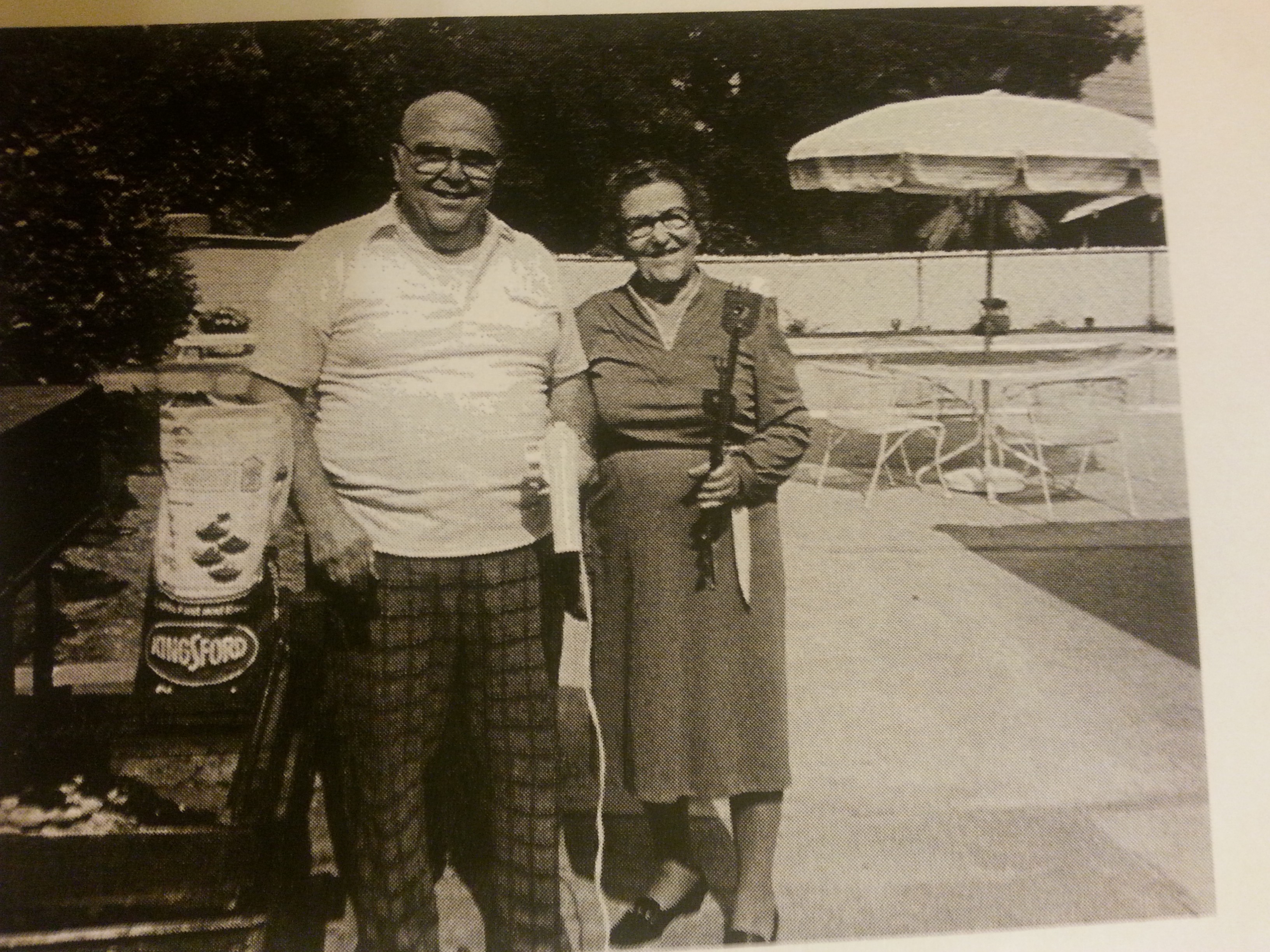
My grandmother, Sona, with Vartouhi (Nana)
My grandmother is gone, her mother is gone–no one is left to show me the way.
I thought attending these comfortably anonymous events would be a different way in–an acknowledgment to myself that I could at the very least learn more. Hear what those who are involved in the diaspora community, who are immersed in Armenian-American culture, think and feel. But I did not go. A ceremony was held for the new memorial in Pasadena, and I was not there. There will be a parade today that I do not attend. I am afraid to impose, afraid to feel like an impostor. I have no right to participate. I have little knowledge and have paid no dues–I am not tapped in to the community.
My great grandmother’s name is Vartouhi. Her story is not unique. I will probably get some details wrong, even in this brief sketch. She fled from Turkey to America by way of marrying an Assyrian whose family was harboring her. She had managed to smuggle Uncle Arto (dressed as a girl), and Auntie Bergie, who she pretended was her daughter. Their parents had been killed as they watched. Too many children could say this by 1920. Too many children can say this now. Once in Washington Heights, an older brother and extended family awaited them and they made a new life. My great-grandmother had two children, worked, divorced, sent her son to war and her daughter to work and got her son back and eventually they all moved to the San Gabriel Valley to start yet another life. Lives. Our family branched and grew. Vartouhi had escaped genocide and created a legacy.

Auntie Bergie (L) with Nana (R)
In the early 1990’s, she sat in one of her favorite chairs in her sunny Pasadena living room and her son video taped her story. I have seen it just once, a few years back. It was strange and wonderful, to see her as I remember her at eight. To hear her voice. She and her story and its transmission and retelling and reinterpretation by my grandmother & mother are the reasons I became politicized around my Armenian identity when I was younger. That she and my grandmother are gone have lessened the immediacy of our family’s past, and have made it easier for me to become alienated from this identity over the years.

Uncle Al with Nana, engaged in a family activity.
My grandmother helped me share our family heritage in 5th grade–it must have been some sort of Grandparents Day or Immigration Celebration or something similarly and singularly Elementary School. We held up a scroll of the Armenian alphabet, unwrapped my grandfather’s Christening gown, and we must have talked about things, as well. Maybe this was the beginning of my blossoming pride. In my early teens, I claimed Armenian identity in earnest. It made me special. If I had lived in Glendale or near Washington Blvd in Pasadena, it would have been less special, but maybe I would have participated in the diaspora community and be able to feel legitimate about claims to an Armenian identity today.

One of my touchstone texts as a teenager struggling to claim Armenian identity.
At 13, I had grand aspirations of learn in to speak the language. I could have–my grandmother was still alive, as was her brother. I read The Road from Home by David Kherdian over and over, book-reported it in English class, told anyone who would listen that I was half Armenian. Looking back, I label myself “obsessed.” In 9th grade, I wrote an abbreviated history, complete with choice gory details, for an extracurricular publication. It drew heavily on a hardback book with a blue cover called The Armenians (I think)–a sweeping history that chronicled the horrors of the genocide. My goal was to shock readers and inspire guilt. It was amateur stuff, fueled by the fire of teenage understanding and the desire to be recognized as something deserving of recognition. My identity was the peg. I’m still glad I wrote about it. I would write it differently today, of course. I’m older. My relationship with my Armenian identity has changed from one marked by pride to one marked by unease.
If you do the math, I am fractionally Armenian–there’s also some Assyrian in there. Every time I try to come up with the actual fraction, I get a headache. “Half” is the default, but it’s probably closer to 3/8. Ethnically, I can claim this Armenian identity. Culturally, this claim rings blatantly false. The last thing my family has are memories and a few recipes we trot out during holidays. Our food is freaking delicious, by the way. We consider Armenian restaurants inferior. They don’t work from Nana’s (Vartouhi’s) recipes, which were kept in her head until the 80’s when a cousin and my mother tried to transcribe what, exactly, “this much” measured in the pinch of her fingers meant.
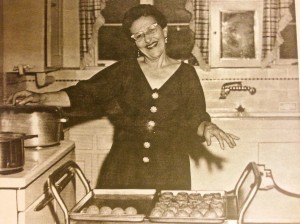
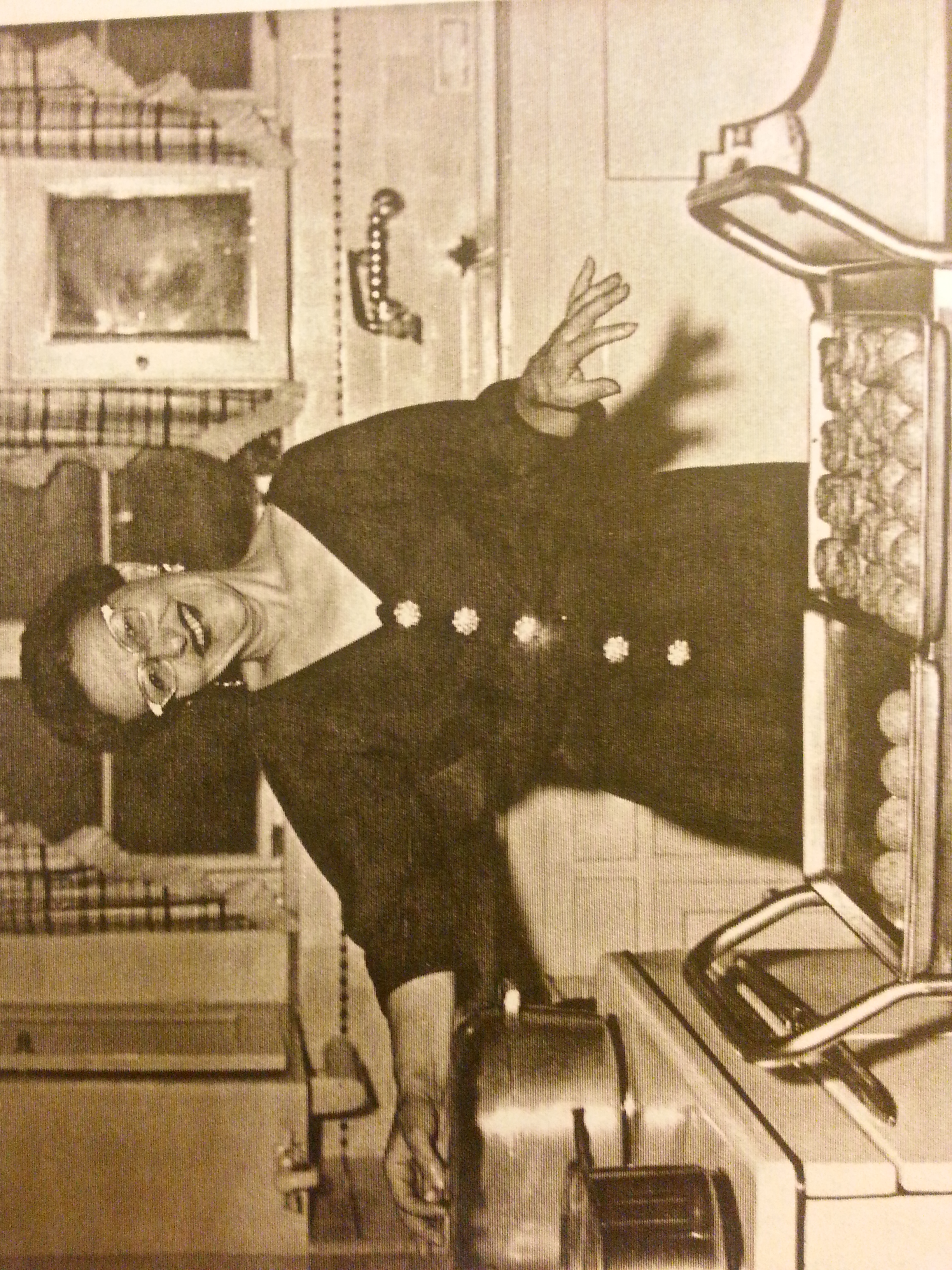
Nana preparing for a Kufta party in the 1950’s
So we don’t use recipes, really. We use what’s in our heads. Each grandchild took responsibility for one dish. One year someone joked that we should consider sharing what has become compartmentalized knowledge & expertise among ourselves. We should probably take this seriously. An Easter without Choereg is no Easter at all, and I don’t even like Choereg. As my generation scatters, the branches of our family unite less frequently. As we Americanize, we share a love for the family food and identify as eaters, but that seems to be the extent of our heritage. Who are we? There are few left who truly remember.
Some of my relatives are still angry. It’s personal. An affront to our family. I used to have this anger, but it has waned. It’s become less personal for me–I didn’t have as much time with the people the genocide affected directly. As the years pass and my experiences with my relatives slip farther from the present, it’s easier for me to think about larger contexts. I’m not sure how I feel about my ability to detach. Certainly I lament my removal from those I love, from the immediacy of experience and into the fading haze of memory.
It’s not my place to forgive.






 Contemporary Contempt