Category Archives: Contemporary

Holding Our Brains in Our Hands

As you’re probably well aware, the robots have arrived, and they’re being marketed at our collective penchant for laziness, gussied up as “convenience.”

Cortana smartphone

The commercial was full of friendly voices, one belonging to a straight male human, the other to a feminized robot living in the human male’s smarphone. They have a conversation, or rather, the male voice asks the female voice to remember things for the slowly atrophying male voice’s brain.

“Cortana, next time my wife calls, remind me to tell her, Happy Anniversary.”

How is this easier? Does female robot secretary really make this process of remembering/doing more seamless? Employing Cortana to assist you with these tasks involves several steps:

Pushing buttons; talking into the phone; confirming that the phone heard you and interpreted your meaning correctly; saving this reminder appropriately; not accidentally activating an irrelevant app; and coming up with the idea one wants to remember in the first place.

The commercial wants us to think that Cortana is erasing the potential for human error, but technology itself is not infallible. What if the battery dies? What if your wife is waiting for you to call? What if relying on Cortana is ruining your marriage?

We’re uploading our memories; outsourcing key cerebral functions. Set a reminder for Cortana to sound the alarm! We’re the agents of our own destruction, depleting our capacity to remember how to be human.

2 Comments

Filed under Contemporary, Deconstructing Commercials, Technology

Impotent Signage: Discouraging Garden Theft in the Modern Suburbs

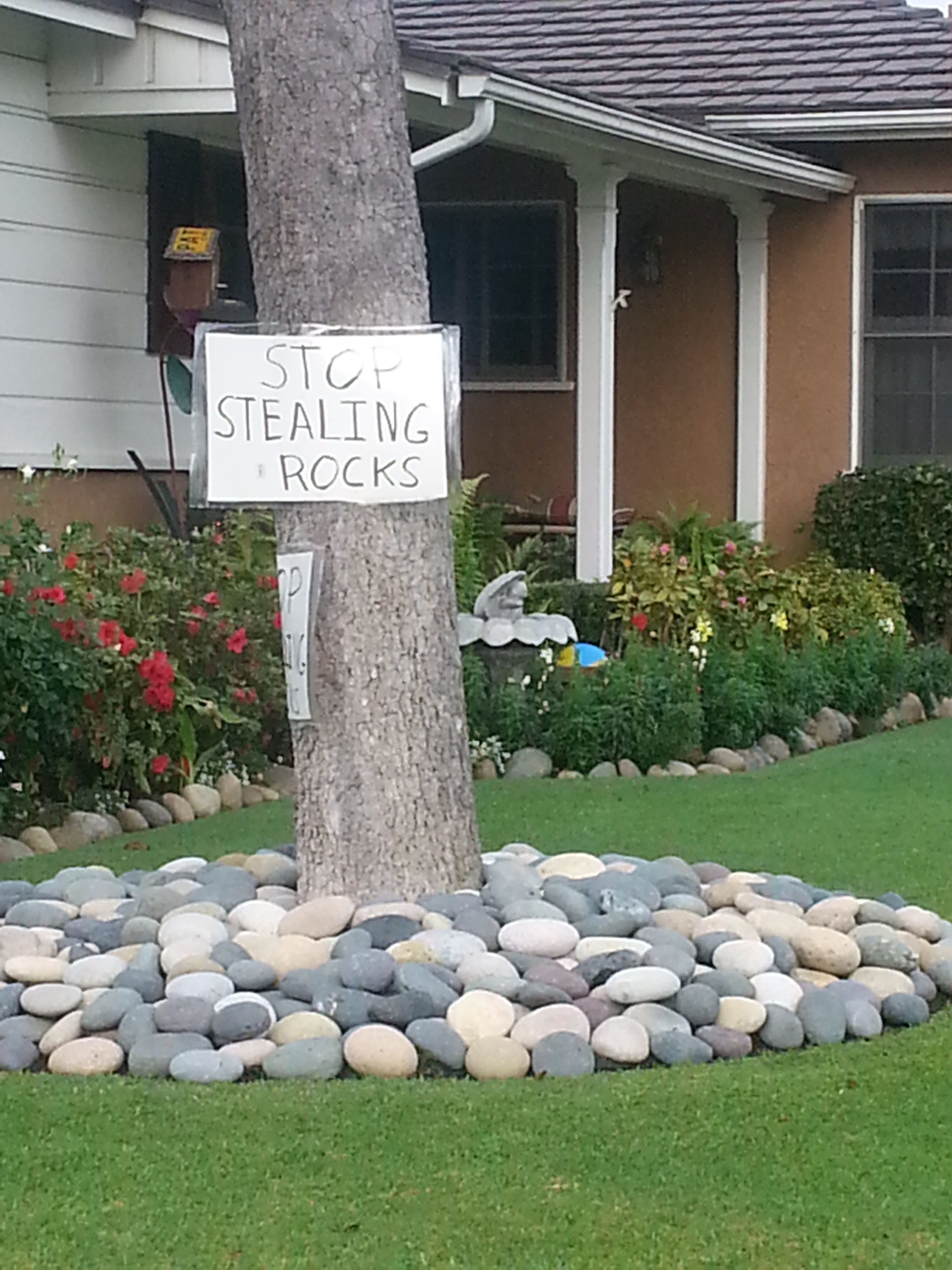
The two poster-boards shout at passers-by in clearly printed black marker. The signs are duplicates of one another, affixed at angles to a tree on a front lawn. The tree is set back far enough from the curb to not be mistaken for a city tree. Crucially, at the base of this tree is a neatly rounded pile of river rocks. At first glance, there are too many rocks to count. But the owners of the tree seem to keep close tabs on the total.

...make me?

…make me?

How I long to call on these people in a week or two and find out if they have seen an increase or a decrease in theft since they put up the signs.

For the signs to work as intended–as a deterrent against further theft–a few things have to happen:

  1. Potential and/or previous rock thieves need to come to the house
  2. Those people must be interpellated (that is, they must consider themselves addressed by the sign and identify as the intended audience of this sign’s imperative message)
  3. They must then feel remorse for their previous or intended actions
  4. They must not feel indignant, as that may lead to rebellion against the sign’s message

That you can see it from the street does not make it public; that you want it does not make it yours; that there are so many to begin with does not change the situation from the owners’ point of view.*

All of this being established, my inclination is that anyone who already feels it is their right to take something from someone else’s lawn will scoff at this feeble attempt to control their behavior and take more rocks just to spite the sign and the passive-aggressive people who wrote it.

I could be wrong. The four steps outlined above may happen. But until these rock owners get a security camera and law enforcement on their side, I do not think their rocks are going to stay put. Not with this futile sign as their only anchor.


* That I took a picture of what these people clearly consider to be their sole property is an ethical grey area, although not getting paid for this piece of writing nudges me more firmly on the “no worries” side of things.

1 Comment

Filed under Contemporary, Power, Wordplay

Half-Baked Motherhood: Compromise & the Dough Boy

There’s a Pillsbury commercial that has been nagging at me to rail on it since late 2014. Here we are, three months later. No time like the present. Unfortunately, I’ve been unable to find a clip of this commercial, so a description based on my memory of having seen it once will have to suffice.

A Commercial Mother encounters the three members of her family as she makes her way through the house. She tries in vain to get the attention of each:

  • Child #1 cannot hear for the headphones that keep him glued to the TV screen on which he’s playing a video game.
  • Child #2 charges down the stairs, nearly running into Mom as she texts on her smartphone.
  • Husband is changing the channels on the TV in the kitchen.

Instead of snatching the devices away from these rude family members like a sane person would, Commercial Mom sighs with an exasperation meant only to underline her infinite maternal patience. There’s even a smile creeping into the corners of her mouth. Oh, family members–can’t live with ’em, can’t get ’em to acknowledge your presence. 

Suddenly, a solution!

We see her pull a steaming sheet of something presumably delicious out of the oven. One by one, each family member unplugs themselves, the irresistible aromas drawing them to the dining room. The closing shot sees them all sitting together, face to face at last. “Nothing brings them to the table like Pillsbury.”

My eyes almost got stuck in the back of my head. I’m really glad I only saw this commercial once, or Feminist Rage and also a very high ophthalmology bill.

As alluded to previously, what I had hoped this mother had done was confiscate the offending devices that were turning her family members into offensive people. Nothing brings ’em to the table like dropping all their technology down the garbage disposal. Also, if we’re being reasonable about things, maybe they could have had a family discussion about why it’s a problem when you don’t acknowledge someone who is trying to talk to you. But no. Commercial Mom gives in to the socio-technological forces swirling around her and tries a different tactic to reach her goal of familial engagement.*

The message of the ad is if you can’t beat ’em, bake for them. Sacrifice. Work harder for what you want. Embrace your family’s foibles. Aren’t people these days a riot, with their technology and lack of interpersonal skills? Why, we should reward them with baked goods–and not just any baked goods, but par-baked goods that make your life of thankless sacrifice a little easier, more palatable. To get what you want–which is, apparently, not respect, but rather the physical presence of your family–you need to meet them more than half-way. You need to meet them half-baked.

What might be most troubling about the existence (and persistence) of this representation of American motherhood and winking maternal “wisdom” is

  1. Many mothers (parents, really) must identify with this representation
    and
  2. These women haven’t yet pushed back to a degree that would manifest itself in market research

Ads are not a mirror of the real world, instead tending to lag slightly behind cultural trends and social mores. But they also serve to reinforce kernels of truth in the collective lived experience. Too much money is riding on the ability of this ad and its representation of modern family life to resonate with its target market for it NOT to have sufficient market research behind it. Market research that told the Pillsbury executives that a significant chunk of American parents feel like the mother in this commercial. A feeling of futility that only our product can alleviate!

Parents in general will likely identify with the mother–so the market research would have shown. You want to be a close-knit family, have quality moments with your children, but modern technology is getting in the way. Luckily, Pillsbury is here to save the day, offering up a product as a solution to the problem the ad offers up on a platter.

This convenient confection is just the sticky substance that will keep your family unit together. If you value your family–if you’re a good mother–you will buy it. Motherhood is a goldmine of social anxieties,and Pillsbury knows it as well as we do.

So instead of the mother laying the smackdown in this commercial–which wouldn’t really present a problem that a Pillsbury product could solve–and teaching her family about the importance of NOT BEING RUDE and RESPECTING OTHER PEOPLE, ESPECIALLY THE PEOPLE WHO GIVE YOU THE LUXURY OF A MIDDLE-CLASS EXISTENCE…we get get the tired trope of sacrificial maternal compromise, repackaged & refrigerated for those struggling to parent the iGeneration.

*I am not making judgments about real-life parenting decisions. In situ, I’m sure plenty of great parents pick their battles and exhale their anger instead of making every moment a teaching one. In this deconstruction I am taking issue with the way the mass-media represents motherhood and family life as a social structure in which the mother is disrespected and then rewards her family for their rudeness. A representation that holds up motherhood as self-sacrificing and somehow still rewarding. A representation that holds up as relate-able, emulate-able, and Good a person who takes shit and bakes it into cookies.

Leave a comment

Filed under Commodification, Contemporary, Deconstructing Commercials, Gender Trouble, Technology

A Case for Applied Anthropology: Let’s Get Personal


In honor of the first National Anthropology Day, I’m going to jump on the bandwagon and write something anthro-related. Or rather, type something anthro-related that I scribbled down in a tiny notebook nearly 2 years ago. 

Imagine, if you will, that it is spring 2013. I’m headed back from the first of a two-day conference of California Cooperatives. I’m neck-deep in a sustained effort to start a community-owned grocery store. I’ve just landed a dream job working with and for people two generations ahead of me at a local non-profit.

My days of suffering through thankless customer service jobs are over. I’m high on collective action. I’m still livid about my graduate school experiences & failures. All these feeling coalesced in a frenzy of brain-waves. The following are the thoughts I rushed to get on paper every which-way as I metroed back from the church basement in Los Angeles where the conference had holed up, ravenous for the life I was experiencing as well as a proper dinner.
Applied anthropology gets a bad rap. Partly for fair reasons, but I’m here to talk about things we don’t think of when those who have the luxury of working the ivory tower use the term pejoratively.

Full disclosure: I am making this case partly as a way to defend the work I do as a natural and positive way to use my academic training.

I consider the work I do to be applied anthropology. Not this blog, which is armchair anth to a fault, but my real-world work. I have the great fortune of being involved in the following projects:

  • At a local history museum, I’m collecting and curating personal memories as part of a virtual exhibit of community stories. Last year, I re-wrote a docent training manual to make room for those groups discursively erased from dominant historical narratives.
  • I am contributing to the start-up phase of a food co-op.
  • I’m working for a non-profit that creates a support network enabling people to stay in their communities of choice as they age.
One of these projects pays me, but I spend arguably more time on the volunteer projects. All of them are local and community-oriented to some degree. And in everything I do for them, I apply my anthropological lens. My training informs my work.

I use the tools and perspectives of cultural and linguistic anthropology to navigate all of this work. I don’t consider this “selling out,” and while it may be an impure form, I do not see it as a bad thing that I’m using the knowledge I and others (have) produce(d) to do very real things. To effect the type of social change we anthros always seem to be advocating for.

I suppose that makes me an activist anthro–another pejorative term. I’m working with folks to address and solve the social problems that anthropologists are so good at identifying. There may well be harm in this endeavor, but there is also a great deal of good.

For example, I use linguistic anthropology for good, not evil. Yes, I’m referring to marketing, but this is marketing for a better future! I haven’t sold out to a corporation, here (unless you count the food co-op). I’m taking the collective will of the people and packaging it for even more people. “Selling” folks on the very ideas they helped to create.

But that’s not what people mean when they snark at those of us who aren’t masochistic enough to be in a PhD program. I admit that I don’t have the temperament to hack it. I’m not into feeling overwhelmed and mentally inferior. I’d much rather be fulfilled, using my skills to engage with my local community and make it a better place.

10170962_624799674378_6831831824286245919_n

Collective production of paper mache’ floats trafficking in mixed metaphors totally makes the world a better place.


All of these are reasons why I like the CCC’s better than the AAA’s. There’s a commitment to putting theory into practice. Turning idealism into action and ideology into reality at a grassroots level. Joining pragmatism with idealism to forge unstoppable forces for good in the world!

Besides, if we sequester ourselves in the ivory tower, if we don’t retain ownership of the knowledge we’ve produced, it has a higher risk of being co-opted and used for evil, rather than the good we intend. There’s nothing shameful in seeing something through, in applying theory to practice.

What’s the point of research if it doesn’t have real-world implications? And who are we if we don’t see the value in implementing those implications of our research?

Instead, let’s embrace the practical applications of our research. Let’s retain ownership–sharing the burden, to be sure, with those who have the experience and power to implement our ideas. Not just handing it off, but sticking around to be active participants. Taking action!

In the two years since this breathless tirade against academia for poo-poo-ing applied anthropology, I’ve mellowed a bit. My involvement in the museum and the co-op has lessened, and my work in the non-profit world, while still rewarding, is definitely work. I’m not quite as bitter about my negative experiences in graduate school, and instead enjoy gazing through nostalgia-tinted glasses at the wonderful undergraduate experiences that drew me to anthropology in the first place.

There is peace. There is still action. The museum endures. The co-op is open, now, thanks to the efforts of many talented people. There is still a case for applied anthropology.


Leave a comment

Filed under Contemporary, Sweeping Generalizations

Lost is Found: taken with the streets

Last night I missed an opportunity to photograph a bike light, blinking red in the middle of the dark street. It was the same type of safety device Flaming Bike had attached to the seat of my pants before literally carting me off on a grand tour of Lake Merritt that quiet night in Oakland. After our apple pie supper, chased with an apple galette dessert. I was thrilled to be her cargo that night. Grateful for the beacon attached to my rear that signaled our safe passage.

The lonely beacon wasn’t the first lost object I had come across that day. Hours before, a discarded draft of a thank you note had been in my walking path. It’s simplicity was touching. I hope the author remembered their words; wrote & sent it for real.

Forgotten thanks, or discarded draft?

Forgotten thanks, or discarded draft?

Not many steps later, a cyclist in serious spandex cased the gutter, riding slowly up and down the half-block, looking left and right, against traffic, clearly missing something. He stopped astride his mount, bent to retrieve a glove, shoved it down his shirt for safekeeping. Then carried on.

The day before, on a walk to the food Co-op, I passed a seemingly abandoned lot, gated and threatening electrocution for the unidentified, absent owner’s safekeeping. Upon closer inspection, I saw defiant plantings of vibrant succulents strewn about. The land had been reclaimed, I imagined, by its neighbors. Given life, if temporarily.

Resistance Gardening

Resistance Gardening

Documenting lost objects is not a new idea, but it intrigues me still. I look forward to sharing future findings as part of a series, “Lost is Found.”

Leave a comment

Filed under Art of all Kinds, Contemporary, Lost is Found