Category Archives: Media

Separate Spheres and Situated Knowledge: Subtly Indexing Gender Stereotypes in a Bounty Commercial

I’d like to haphazardly discuss yet another example of the stealthy pervasiveness of gender stereotypes in U.S. culture. This example is from a nationally (and maybe internationally) televised commercial for Bounty paper towels. Perhaps you’ve seen it of late.

This commercial makes use of what I would call harmful gender tropes to market its product to consumers. Because it was created to be mass-mediated and appeal to as many (female) consumers as possible, one might argue that such commercials have to extend to and re-create certain structures of cultural categories, no matter how stereotypical and harmful these representations may be of culturally created groups of people. Otherwise, they would not be comprehensible to a wide audience. But I argue that such use of stereotypical representations are yet another example of gendered norms being held up as natural, with implications for what roles differentially gendered people are expected to play in our culture.

This commercial in particular offers up women and men as possessed of differentially valued sets of knowledge by virtue of their being women or men. This has to do with how gender intersects with the notion of separate-spheres: the idea that people generally inhabit either the public or private sphere on the basis of their being women or men. (Things are never this neat in real life, of course, and never have been.) However, the intersections of these false dichotomies (men:women :: public:private) is the assumption upon which one of the messages of this commercial rests: that women “know better” than men how to clean up messes because of the particular knowledge they have thanks to their primarily inhabiting the private sphere.

Now for a description of the commercial itself. Please note that the voice-over quote is most likely a paraphrase, as I could only find the commercial online en Espanol. To see for yourselves and to have a better basis to disagree with my analysis, here’s a link to the commercial: http://www.youtube.com/watch?v=BCbSCzvMYxY (The sound is off by a few seconds.) And if you don’t want to watch it, I’m going to describe it, anyway. Lucky you.

Two young girls (sisters?) are baking and dancing in the kitchen as a woman and man (one or both of the girls’ parents) go about their daily lives nearby. Theirs is an open floor-plan, so one can assume that the adults are “supervising” from the adjacent breakfast nook or dining room table. Mom’s at the table working on a laptop computer, Dad’s relocating a small houseplant to an undisclosed location. The houseplant is never heard from again. When Dad’s slightly behind Mother, they both look over to the kitchen and smile at the girls who are having so much fun mixing ingredients with dancing.

Because this is a Bounty commercial, a sudden mis-calculated hip-check delivered by older girl to younger sets off a chain reaction, sending a glass flying. Its contents spill neatly across the counter. (Finally, Bounty thinks. I’ve been off-stage for quite long enough, thank you.) Father bends over to look at the mess as Mother walks behind him. Her voice-over says, “My husband? Thinks this is a three-sheeter.” She pauses and smiles at his somewhat befuddled worry, then continues walking to the roll of paper towels, which the older of the two girls has pulled in anticipation of the clean-up. Older girl, presumably taking a cue from Father’s view of the world, offers about three sheets worth.

Not so fast! Mother stops the spinning in the nick of time and cheerfully reprimands this folly, half-wagging her finger and half-using it to indicate that no, they only need one sheet of paper towel. Because Bounty’s just that awesome. Older girl relinquishes the end of the roll to Mother, who winds it back and deftly rips off just one sheet. Then the requisite test: women’s hands do the side-by-side cleaning of Bounty-vs-notBounty paper towels. Cut to Mother cleaning up the mess the girls made with that one sheet. The two girls are seen in the background, talking and smiling in a corner of the kitchen. (Why aren’t they cleaning up their own mess? But that’s another issue.) Mother smiles at the now-clean counter. Thanks, Bounty.

Cut to the happy ending. Older girl carries a now-finished cake of Dr. Seuss proportions over to where the rest of the family stands, ready with a stack of plates and say-cheese smiles. Everyone basks in the ridiculousness of the cake. They are proud. Then the cake implodes, sinking into itself. Four human heads trace its spatial deflation in familial whimsy. Cut to more paper towel vs. kitchen counter action. Take that, spilled fruit punch! BAM: BOUNTY. (don’t forget to try our napkins!)

The End

So, remember up there when I was talking about separate spheres? I sussed that out from that one-line voice over, but a lot of the images and the attitudes that the mother and father characters visually exude back this up. The mother addresses the audience and expects us to identify with her exasperation over her husband’s misguided counting: “three sheets, he thinks—three! Silly man with his man-knowledge…clearly he knows nothing about cleaning with Bounty—am I right, ladies?!!”

It is the woman who is held up as the correct one in this scenario; the adult who has the privileged knowledge about cleaning and cleaning with Bounty in particular. Her authority comes from the fact that she is the woman, the mother: that she inhabits the female role that is relegated to the private sphere, where the household cleaning is done. The mother’s knowledge is situated here in the home—laptop-work notwithstanding—and gendered female, and because the scenario is taking place in this sphere, her female private-sphere situated knowledge is privileged as authoritative.

The husband’s assessment of the situation and the solution it requires is rejected because he, being a man, is not privy to the privately-situated female knowledge about cleaning kitchen counters with Bounty paper towels. Poor man, how could he know—he may be carrying a houseplant, but his knowledge is still mostly male. His male knowledge comes from the public sphere, where there are no kitchen counters to be cleaned. Without getting into second- and third-order indexicality, just trust me when I say that these gendered associations correlate in all directions.

The commercial uses these gendered associations in order to connect with its audience: ladies, don’t you find it hilarious when men don’t know how to economically dispose of waste? Aren’t you happy to be so wise in the ways of housework? Now get back in that kitchen where you belong. Where you are the master of disaster because you are a woman. This conglomeration of gendered stereotypes is harmful to both women and men: it makes a joke of men attempting to take on more traditionally “female” roles, effectively keeping them from mastering housecleaning tasks because the stereotypes assume that, being male, they do not possess the requisite knowledge to clean house effectively. They are laughed away from the merest hint of an attempt to understand the situation of cleaning up a kitchen counter spill. Men are simply no good at this; everyone knows that. (This is where I could go off on a tirade about 90s 3rd-wave feminism that sadly persists today, whose power comes from reinforcing gendered stereotypes with a favor for femaleness instead of maleness, and taking pot-shots at men and their stereotypical male ways. But I will refrain from delving into this issue. For now.)

Back to the gendered assumptions in the Bounty commercial. I’ve discussed why they are harmful to men.  These stereotypes are harmful to women because they assume that by virtue of their gender, they are automatically better-equipped to handle crises of the home variety. This effectively relegates them to the role of home-maker, expecting them to know how to cook and clean, etc. To have the knowledge/expertise to do so efficiently, and with the right branded products.

The overall effect of the proliferation of mass-mediated images and other representations that employ gendered stereotypes is that society as a whole loses by forcing everyone into a binary system of gendered roles and expectations. We are capable of so much more! So much more variation if we only allowed ourselves to be open to them… Woe betide the gendered person who tries to cross these lines separating tasks based on gendered spheres: you will become the butt of a joke in a commercial. Or worse yet, the punch-line to joke numbers 1-26 on a sitcom. In America, we still create images that reinforce these gender stereotypes and mass-mediate them, further entrenching them into the social consciousness. Mother knows best when it comes to kitchen messes, and Father is just a helpless bystander to be pitied for his lack of female/private-sphere knowledge. Am I right, ladies?

1 Comment

Filed under Contemporary, Deconstructing Commercials, Gender Trouble, Media

Merrily Spring-boarding from a Book Review to Thoughts on Nostalgia: A Review of a Review of “Ready Player One”

In the September 5th issue of Time magazine, there was a one-page book review of Ernest Cline’s Ready Player One. This post isn’t going to discuss the book itself, as I haven’t read it, but rather some issues that the reviewer, Douglas Wolk, touched upon in his article.

Briefly, the book seems to be about 1980s video games being played  in a dystopian future, and one game in particular that, if beaten, can give the winner unimaginable riches. In his review, Mr. Wolk points out that this book has been talked about for a while now, and that this talk is “acutely nostalgic.” Then he goes on to a section entitled “Pop Culture Eats Itself.” Yum!

Wolk ties the excitement surrounding this novel to a particular idea presented in Simon Reynold’s Retromania: Pop Culture’s Addiction to Its Own Past. The idea being that the current turn in artistic expression is toward rehashing. Toward the celebration of the bygone. Toward nostalgia. Sequels and mass-culture entertainment drawn from existing stories and cultural landmarks abound. The presumption is that art used to, once upon a “better” time, strive for originality. (This is itself a nostalgic lament.) I would point out that all this re-making and referencing capitalizes on an imagined audience’s predilection for nostalgia. After all, movies and books and even some visual art gets produced because those with the money to back these projects believe that they will see a return on their investment. This artistic turn toward nostalgia that Wolk and Reynolds note we’re being bombarded with in popular culture is in no small part in the service of marketing. In the service of commodifying (self)reflexive nostalgia to feed the masses, in the hopes that they might fill the pocket-books of the creators and their patrons (if we want to stick with the idea that this is all art in some form or another).*

Onto a second, slightly related point that comes up in the article about the value of nostalgia in and of itself–at least in the world of (pop)art/culture. Again, my thoughts have strict limitations as I have not read any of the books being referenced in his review (shame on me!), but when Wolk writes that we should rue the day that science fiction starts looking toward the past (and, oh crap, thanks to Cline’s book, that day is today!), I wonder what kind of “trouble” he thinks we’re in, either creatively or socially. He concedes that “all that crap clearly meant something to people,” but bemoans the fact that Cline’s book doesn’t explore this. It just presents the 1980s games as a saving grace in and of themselves for the inhabitants of the dystopian future. (Oh yeah, there was also that winning money thing.) Wolk thinks there should be more commentary on that meaning.

Wolk essentially criticizes Cline’s novel for glorifying something that isn’t real enough; that does little to push the boundaries and say something new as it presents the nostalgic for mass consumption. Or maybe he’s angry that the glorification offers little analysis or critique. In any case, Wolk claims that this building-upon and making-new is an artist’s job, “not just to offer up comforting familiarity as a talisman against the void.” But I wonder if perhaps this could be one of the points of Cline’s book: that nostalgia is emptier than we’d like it to be.

*One final tidbit: Wolk refers to what he sees as Cline’s overuse of pop-culture references to the 1980s as “maddeningly fetishistic.” Exactly.

2 Comments

Filed under Art of all Kinds, Book Reviews, Commodification, Media

Profitable Discourse: NBC’s “Education Nation”

There have been quite a few ads for this new segment/series on NBC stations. While conversation about the state of education is great, what struck me was that this feels like a corporation seizing upon a sexy topic–one of concern for many citizens–and capitalizing on it. After all, news conglomerates are businesses. For-profit businesses. To get advertisers to buy space, they have to ensure that people will consume the news they disseminate. Hey, people seem to be worried about education–let’s create a series, website, and blog that speaks to those concerns.  That’ll get them to watch! And how handy: a catchy, rhyming title. They’ll associate our name, our logo, our news brand, with what matters to them! 

Discourse (much of which has been created or at least fueled by the mass-media, let’s not forget) is yet another opportunity to build the brand. By associating NBC with what is perceived to be a social good–public education–capitalism wins again. These ongoing, mediated conversations promise to “make a difference” to viewers and participators…and to the corporation’s pocketbook. It’s profit masquerading as a practical response to national discourse and those topics that are latched onto in waves of hand-wringing and fist-clenching. Capitalism in the trappings of populism.

To piggy-back on the idea of public discourse, the fact that national news corporations now deal with broad topics of concern is symptomatic of how our society interacts. We think of ourselves as a nation. Locality is still there, but we pay overwhelming attention to things that are perceived to concern our state, our country as a whole. The village we belong to has grown. Our community has become televised, and our neighborhood is now online. These are gross over-generalizations, of course, and it would be worth exploring whether or not this move to exponentially larger circles of community and the ways in which they are mediated is mirrored by a refocusing on ever-smaller local identities, such as towns and neighborhoods. As we strengthen our national identity, do we simultaneously cling to the micro-concerns of our local identity?

Either way, news corporations have us covered. Oh boy, are we covered. They know what we care about, what will make us watch, and they know how to get us to care about things, as well. Perhaps this move shouldn’t be derided too much, as it probably will lead to productive conversations about how to improve the educational system, whether those conversations lead to actual positive changes or not. It’ll be interesting to monitor this series and its partner website to see what NBC decides to focus on. And it’s always worth looking critically at things from different perspectives, especially if they seem oddly benevolent.

4 Comments

Filed under Contemporary, Media

Beef So Fresh It’s a Cash Cow

Turning life into food isn't free

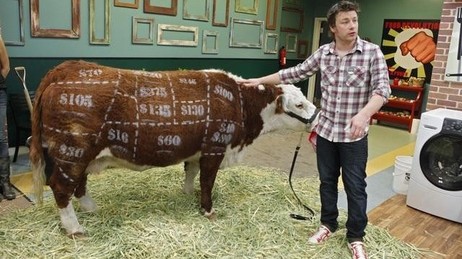
First, a disclaimer–this is neither well-thought out nor well written. Also, here is the NPR article that goes with this picture. Photo credit is Greg Zabilski/ABC. Now to the somewhat predictable spin-off rant:

The host of this show (human pictured above) apparently wants people to think about what they are eating. And to think about it as a good American consumer would: in terms of how much it costs. This is veiled in the guise of encouraging more healthy eating (does cheaper automatically equal less healthy?). I’m not criticizing his project as a whole, just pointing to a few implications it has, or, more accurately, the delicious implications of the image above. (I’m also not criticizing the NPR story, which is focused on different issues and is worth reading for itself, especially if you want to know more about the TV show that this image is from.)

I frequently (some might say obsessively) use bovines to explore a lot of cultural issues, and this image and its accompanying article smacks you in the face with a few of them: animals-as-food, commodification of life, and placing monetary value on the spoils of death, to name a few. This cow is being used as a powerful device to illustrate to people how much they are paying for which cuts of meat. It is powerful, for one reason, because the connection between the live animal and its edible products are normally not illustrated so graphically. Cash value has been physically inscribed on a live animal that will, ostensibly, be killed and eaten. This cow stands for the idea of nutritional value for one’s money, and stands for all the beef that Americans consume. (I do wonder if the show at all addresses how value is added to cattle and the various cuts of meat they become…and this reminds me that I should really re-read and do a book review of Shukin’s Animal Capital.)

Honestly, I just love how blatantly monetary value is inscribed on this animal–it becomes a thing, a commodity, right before our eyes, even as it continues to embody movements that might be construed as independent and life-like. But this animals isn’t given a subjectivity of its own. Rather, it is made an object of education; a symbol of itself as a heavily used commodity in the U.S., of American eating and spending habits, of many things, just in this one image. The human next to it uses the animal and makes it mean certain things for his audience; lays his hand on its shoulder as if its body were a blackboard–as, indeed, it has been visually manipulated to become. It is on a leash, and at any moment the man can pick up the other end and have this mobile blackboard tethered to him–the man is in control of this might-as-well-be-dinner educational tool. (Unrelated note: wtf is with the washing machine in the right-hand corner?) This animal is marked for consumption–both as a commodity and as an eventual collection of differentially priced food items.

I just find this all very interesting, is all, and when I come across images such as this one which so clearly capture America’s relationship with food animals and consumerism, I squeal a little inside and have to share it. Mmm…semiotics!

4 Comments

Filed under Beginning of the Body, Bovinity Infinity, Commodification, Contemporary, Media, Television and Movies

A Fragment: Practice Makes Meaning(?)

I had this half-baked thought back in March, when I read the headline of a news story about the possible impending government shut-down in the U.S. It’s sort of still relevant, topically, and the argument I jump to from the topic is almost always relevant, so here we go:

In the news story, the possibility of the (then) current government shut-down was automatically compared to that of 1996. Maybe this is a valid parallel, but it might not be. The contexts of the shut-downs, the possible causes, will necessarily be very different. They are located in different socio-historical moments, after all. But in mass-mediated news, even publicly-funded news outlets, those contextual details get lost in favor of familiar narratives and neatly packaged parallels. And then future historical narrative–as presented by the media, at least, and perhaps high school text books, will remember the parallel and constructed similarities of the incidents, if it remembers these two incidents at all. (Maybe they won’t–maybe they’ll stress the differences. I can’t predict the future. But the two incidents will, in all likelihood, be compared and packaged together in some way. The will reference one another and thus imply similarity.)

The larger point is that, regardless of context, political discourse and the way in which it is structured, both internally and as a genre with all its connections and within the wider culture–and importantly, the ways in which it is mediated to various segments of society (pundits, the public, the politicians themselves, etc)–makes these instances meaningful. In this case, the mediated political discourse makes the parallel a talking point, maybe even an accepted truth, because of the way that political discourse and the media frame events–stripping them of context to make that neat parallel. (This argument just got dangerously circular, but hopefully it’ll pull out.)

Other types of narrative and rhetorical tricks and performatives exist as well, parallelism is just one of them. One easily understood and accepted by the masses, perhaps because it is so often relied upon to make the news familiar and digestible. To make the masses return to particular outlets for their updates, to make students remember things in history classes. Familiar narrative structures win over the unexpected and un-categorizable. The latter is just an unexplainable horror until it can be narratively stretched and twisted until it fits into a safely shaped box.

Anyway, one point I want to return to is that use makes meaning. Saying it and repeating it makes something true: political discourse and historical narratives like patterns. Patterns are safe. And the patterns become reality. The idea that meaning comes from use is a tired argument, itself, and the basis for a lot of anthropology, but it seems to hold up when confronted with fieldwork data. (But perhaps we anthros are just making that fit into our own familiar, underlying-premise box. Disciplinary existential crisis warning!) Back to the topic that started this whole fragmented musing, reporting things makes them relevant to the debate; to the voters; to the election. The media and the pundits do have power: they have the power to shape the debate. And on a larger scale, the historians have the power to shape the grand narrative. Not sure exactly the ways in which those two entities are related, but they are…maybe someone else has the energy to unpack that messy box.
Returning to the potentially obvious conclusion, meaning comes from use, and performativity. Practice proves it. Maybe.

3 Comments

Filed under Contemporary, Media