Category Archives: Contemporary

A Question on Appropriate Analytical Tactics

This question came to me during breakfast while watching a morning “news” show. I’d like to think they were doing a segment on consumer advocacy or reports, but it’s just as likely this thought came to me out of the blue:

In a consumer culture such as ours, is a Marxian analysis of the means and mode(s) of production still relevant? When the emphasis is so heavily on the consumer side, is it even useful to think of power in terms of who controls production? Or is the real power more in the hands of the hegemony, which convinces most of us that it is consumption that counts? And in any case, what does it say about our socio-economic system, about the state of things, that our main source of “power”–or at least the source most consciously realized and discussed–is consumptive?

In a sense, that’s not even power at all…although this is where I tend to slip back into Marx (is there a way to avoid it?)…but it’s not “real” power because it’s not just consumer demand that dictates production and makes companies rise and fall–it’s capitalist interest. That elusive yet pervasive “good” that we discursively (and mentally–subconsciously?) glorify yet only understand through well-worn metaphors and (misguided) faith. And it’s marketers who influence consumption patterns, by studying and exploiting them. It’s all related in a convoluted chain of powerful influences in the (ultimate?) service of increasing capital. And we consumers–the identity that all of us are encouraged to wear like a badge of honor–don’t have nearly the power we think we do.

But this does little to answer my original question about the relevance of a Marxian analysis in the face of our overwhelmingly consumerist society, because I just slipped so easily back into Marx up there. Almost too easily…Marx may be useful if only because he helps us dispel the hegemonic myths about the culture in which we live: a Marxian analysis helps us to see the production side of things that tends to be obscured, even as it is vaguely glorified in the “jobs” trope that is so in vogue right now. And of course there is always commodity fetishism, a big part of our consumer culture. But the working class has yet to come to mass consciousness, and I still want something that’s a better fit to describe what’s going on at the consumer level that’s so in the forefront of our national consciousness, while at the same time taking into account what is obscured by this focus on these gargantuan myths of the power of this hegemonically imposed and nearly-universally embraced identity. I want it all revealed and deconstructed and fit back together in a contemporarily sensical way.

Perhaps I need more Gramsci to understand what’s going on, but what I really want is an analytic that is for us–that is grounded in this culture and this time, not imposed from another, however appropriate or partially relevant it may seem. However well we try to make it fit. It just doesn’t do enough to completely understand what the hell is going on, here. And there probably is at least one, I’m just having some difficultly remember what it is. A little help, folks?

3 Comments

Filed under Commodification, Contemporary, Power

Mouthing Off: Using the Absence of Sex to Sell

Linguistic anthropologists do it with words. And so do advertisers.

“Practice Safe Breath.” That’s the tagline of an ad campaign for Dentyne Ice gum. It’s a clever conceit: in these commercials, couples are usually getting hot and heavy, or it’s implied that they want to. Then there’s the inevitable pause: did you, um…remember the, uh…? Shit, I’ll be right back. A race to the roommate’s room. Please, buddy, just this once, I’ll get you back. She’s super hot and what’s even better is that she’s actually on the couch. Disinterested roommate motions to the top drawer of his night-stand, where the hero gratefully extracts a…pack of gum. Whew! First base shenanigans can continue without fear.

This is all designed to evoke the culturally sanctioned practice of having “safe” sex with condoms. And this association is designed to be viewed as a clever twist on the familiar, thereby making consumers want to buy this particular gum because its ads are clever-funny. By triggering these now-ingrained cultural associations with the phrase “practice safe breath,” this commercial effectively implies the existence of sex by withholding it; by providing a twist ending to its little romantic vignettes: haha, dirty-minded viewers! You thought we were talking about condoms but we were really talking about gum! Aren’t we clever and hip?

The very existence of this ad campaign, and the reason its commercials work and make sense, is due to the fact that practicing safe sex has become mainstream–it’s solidified in our cultural vocabulary and social practice. So much so that it is now assumed that everyone knows they should (ah, prescriptive society…) use some sort of protection and shouldn’t have to be told via PSAs or Trojan commercials with pigs standing in for men who don’t carry condoms. (I will avoid digressing into a tirade on the use of nonhuman animals as representative of negative human character attributes, so count yourselves as lucky. This time.)

On another level, these commercials work (in that they may contribute to a rise in the company’s sales) by catering to the social fear of ruining one’s romantic chances with a perceived bodily imperfection. Our bodies, our anxieties. Advertising has a long history of creating problems for which there just happens to be a commodified solution–and ads are so ubiquitous that they end up influencing social opinion and practice by hammering at these invented problems.

Take our cultural obsession with fresh breath, to which this Dentyne Ice campaign owes its existence. The social problem of “bad breath” was effectively produced by advertisers in the 1920s, and maybe earlier, I’m just too lazy to check my sources on this. A slew of print ads ran in highly circulated magazines and newspapers showing beautiful but sad-looking young women in front of mirrors, wondering why they weren’t being courted like their friends. What’s wrong with me? Alas, it was because of an invisible problem: halitosis! Thankfully, there were products to cure her of this (invented) ailment. And she got knocked up happily ever after. Thanks, advertising!

In this sense, the language in advertisements is perlocutionary–the phrases work performatively to create the problem for which the product being advertised is the solution in situ. Saying it makes it so.* I’m not claiming any of this is my idea (see Marchand 1985 and Strasser 1989 for the ad stuff, and Austin 1962 for the problematic performativity thing)–I’m merely pointing to the Dentyne Ice campaign as a recent example of it.

To go back to the first point, where the idea of safe sex has been taken up and re-worked within the context of the campaign to evoke both its origin (safe sex) and to mean something different that still lies within the parameters of canoodling. It’s a wink to everyone in the cultural know: see what we did there? We changed one word and made you think of gum as a conduit to sex. The implication is that “safe breath” leads to “safe sex” even as it remembers it as its phraseological parent. Or at least a second date and maybe second base, for which there are other commercially advertised products that can answer to even more invented bodily “problems” you will encounter there.

Dentyne Ice’s website even has a large banner now that expands on the whole play-on-PSAs/Trojan commercials trope: Society for a Safe Breath America! This is your mouth on ice. All the familiar phrases are there “responsibly,” “taking a stand,” “show your support.” It’s like a MADD-AntiDrug-PlannedParenthood mashup of slogans over there. All being taken up, placed in a new context, given newish meaning, (and effectively made fun of) to sell gum. Language and our very cultural concepts are here but tools of the capitalist machine, placed in the hands of advertisers to help us see the error of our ways and offer us help to correct them…for just $1.49

So keep worrying about your bodies, everyone, because we your friendly advertisers all know what you really want (sexy fun times) and we aren’t afraid to feed all these anxieties we’ve so generously given to you so we can offer relief in the form of commodities. You’re welcome.

*I’m ignoring the other, very important side of this, which is uptake, because this analysis is a reading only, not an exploration of how people interact with these advertisements. This aside has been brought to you by the wish to nip a certain intelligent PhD candidate’s inevitable critique of my half-hearted analysis in the bud.

References

Austin, John L. 1962. How to Do Things with Words. Oxford: Oxford University Press

Marchand, Rolland. 1985. Advertising the American Dream: Making Way for Modernity 1920-1940. Berkeley: University of California Press.

Strasser, Susan. 1989. Satisfaction Guaranteed: The Making of the American Mass Market. Washington: Smithsonian Books.

Leave a comment

Filed under Contemporary, Deconstructing Commercials, Wordplay

On the Superiority of German Playgrounds: A Photo-Essay with a Dubious Argument and One-sided Evidence

During recent travels in Northern Europe (please excuse the pretentiousness) I was taken by the variety and creativity of German playground equipment. It struck me how hideous (okay, so that’s a subjective aesthetic evaluation) and clone-like the playgrounds in the U.S. tend to be. Cookie-cutter jungle-gyms, swing sets, and slides. Not much that feeds the imagination. They are getting better, but they still have a ways to go if the goal is a magical land of outdoor play-time. Feast your eyes on these German examples and see if you don’t agree that we could learn something about incorporating whimsy and general awesomeness into our parks designed for children.

First, a relatively simple one:

This mundane park in a suburb of Bremerhaven consists of two sandboxes, a slide, a swing-set, and a spring-loaded, rocking, red animal-thing. I can attest to the fun-factor of this playground, as I used it extensively during my toddler years. The equipment has been there since before I arrived on the scene in ’86, so there’s also a sturdy factor involved in the manufacturing of German playground equipment.

Next, we journey to Berlin, a grown-up playground of beautiful graffiti, imposing communist architecture, historical monuments and museums for atrocities, a nightlife catering to the unemployed masses, and somewhat surprisingly child-friendly areas. As I wandered back toward the hostel one afternoon, I came across a hippie paradise for children and their parents. Allow me to demonstrate:

This is a collaborative community project of a park geared toward the non-adult population. It went on for days and had a waffle stand (the deliciousness of which I can vouch for), a community center, an area for smaller children with hills and artsy places to climb, and postings for classes and happenings. When I visited it was still being worked on and I imagine it was an ongoing process of creativity. A man was busy shoving fence posts into the dirt as a passing boy watched, and you could hear all sorts of banging and sawing going on in the back. It was a creative mecca.


It also had a bunny zoo.


And a water section. In another area, there was a fire pit going and some dangerously steep slides for teenagers.


Just look at this amazing community center entrance!

As you can see from the striped tape, it was still under construction…or maybe they were trying to encourage the grass to grow.


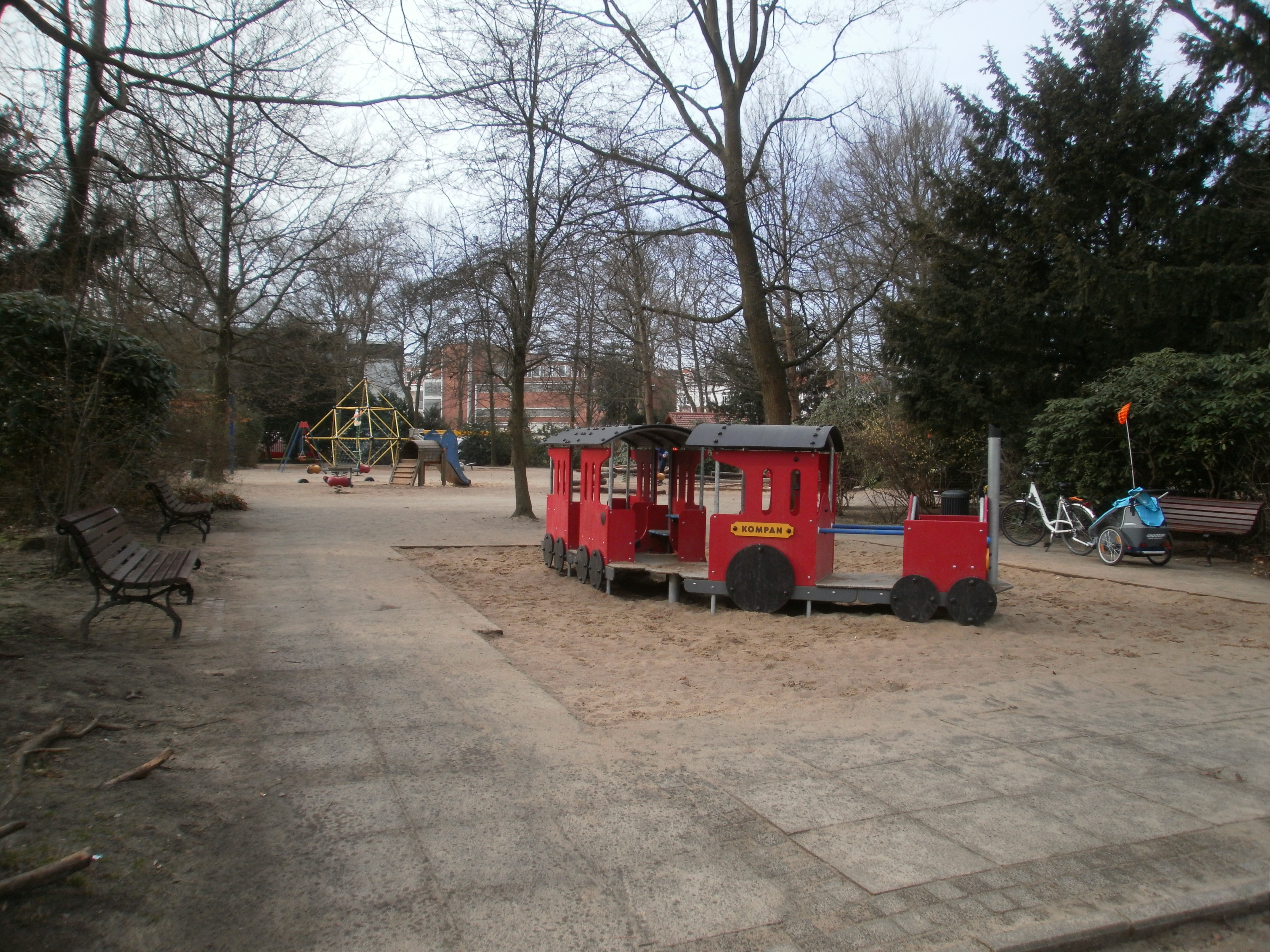
Last, we journey to Bergadorf, a suburb of Hamburg, to what I affectionately and nostalgically refer to as “Dawn’s Park.”

Okay, big deal. This is just a train. It doesn’t event go anywhere.


BAM! Blue elephant slide.


And a wiggily crocodile!


In conclusion, German playgrounds are superior to their U.S. counterparts because they are all like this. Seriously awesome in unique ways. So catch up, America. Don’t make me take my hypothetical offspring elsewhere for their formative years…you may never get them and their future taxes back.

3 Comments

Filed under Art of all Kinds, Contemporary, Sweeping Generalizations

The Cloud: Harbinger of Potential Paradigm Shift

This relates to the previous post about technology and cultural change. In the news lately has been mention of Apple’s jumping onto the cloud bandwagon. As you probably know, this model of data purchase and storage keeps one’s files in the ether, so that they are accessible to you from any device with an internet connection. [cue inspirational music] No longer will our hard-drives be plagued with the tyranny of space-hogging music files! No longer must we contemplate whether or not to download that latest movie or television show! Now, we can just stream them, more or less, anytime we want, because these companies know that we own it.

This has curious implications for society’s concept of ownership. This type of technology uses an ownership-as-access model, rather than the more traditional ownership-as-possession model. Instead of physically having something (however broad the definition of “physically” has become recently because of all this technology), what we now have is access to that something any time we want. This change has been prepared for, I’d argue, because of previous technology like digital music (to replace physically tangible entities such as vinyl records and CDs). We have become accustomed to gradually separating the idea that we have something with the physical existence of that something. And we seem to be accepting it. Perhaps it’s not problematic at all, but I can see scenarios where this (new?) association of ownership with access, rather than possession, could become legally complicated. Or, it may become the case that because ownership is becoming dominantly associated with access, that access will come to stand for–or at least will become associated itself with–possession.

In any case, this seems to be an important, underlying paradigm shift that is not getting quite the attention or discussion that the miraculous new technology itself is getting. Maybe we’re heading toward a more communal model or ownership–where we all together own and help to store the things we consider ourselves to have. But I highly doubt people in America will think of it that way. These music files I’d essentially share with the large companies who store them for us, and the millions of other consumers who have access to them, are mine.

3 Comments

Filed under Contemporary, Technology

We Cannot Prepare for the Future: The Inescapable Exclusion of Segments of the Population from Society on the Basis of Age*

Can we, the youth, imagine a time when we won’t know what’s going on? Because it’s going to happen.

Culture changes, usually. This is natural. In Western societies, these changes are intertwined with technological “development.” As different technologies and ways of doing things are adopted by society at large, the old are often left behind. Technology kills parts of culture, altering them to nearly unrecognizable states of being. As new technologies are taken up, not everyone can keep up. Those set in their ways are left in the dark, relegated to less participatory modes of existing in society. This happens especially to the older generations. Perhaps it is because they are not as involved in the development of these new technologies, these new modes of societal interaction. Perhaps they have hit maximum capacity when it comes to learning new things, to keeping up with all these changes by reading about them. After all, when you aren’t immersed in these changes, you start to lose the background necessary to comprehend all that comes after. The young inherit the earth, and infuse the society at large with their culture. Hegemonic change disenfranchises the older generations.

This will happen to us, too. Sure, we can keep pace with new technology now, but we won’t always be able to. There comes a time, for most of us, when we decide it’s enough: we have all we need; we can exist in a current mode. And we stop adopting the latest things. When this happens in one’s life cycle varies, but it isn’t a problem at first. Who cares if we don’t understand every little thing our kids or nieces and nephews are talking about? We’re functioning just fine as adults in the world, thanks. We have all we need.

But as we age, we become less able to care for ourselves. We rely on others, younger people who have kept abreast of cultural changes; who know the newest technologies. And their knowledge of the world suddenly overcomes our own: we are no longer in charge of ourselves. We do not know quite how to operate in this brave new world taken over by the young with their new-fangled gadgets and ways of communicating. This loss of control, of knowledge, of feeling like you can exist competently, invades even the smallest, most mundane aspects of culture.

A few years ago, a 90-year-old friend of mine complained that she could no longer do the crossword puzzles in the newspaper because there were so many words she did not know. Words like “iPod.” Trying to explain these words to her and what they represented in the culture just caused her to wave her hand at me, as if to suggest that keeping up was a lost cause. (She could still watch Jeopardy, though, turned up to ear-splitting level.)

At any rate, as members of the current youth generation, the ones employed in sectors that develop and/or use new technologies we feel on top of things. We don’t understand or use every single little gadget that comes out, nor do we understand every nuance of society shifts, but we still feel generally confident about making our way through the world. This confidence allows us to harbor the fantasy that all the changes we are living through are becoming the new status quo–and will remain hegemonic. But at this rate of change–or any rate of change, really, this cannot be the case. There is no way to prepare for how out of touch we will become as we age.

Just look at how things such as the car changed society. Entire infrastructures, ways of procuring food, distances considered manageable, all changed. Changes in media technologies are also a good example. Radio and television changed the way we learned about the world, and how wide a radius of the world we knew about. It changed the ways in which we interacted with people: family, friends, strangers on shows, even. And who on earth was prepared for what the internet has done? Talk about altering the fabric of society with a “simple” medium of communication.

We simply cannot conceive of what’s coming and the changes new ideas and technologies will trigger. The flip-side of this–or at least, a related consequence, is the loss of cultural knowledge. Those of use alive in Western societies today would not know how to operate in a world without natural gas, or telephones, or national voting systems, or any number of things. We do not as a society know how to grow food for our families, wear knickerbockers, or make candles.

Societal and technological changes are constant and mutually constitutive: there is no escape. Not from the loss of culture, from the generational disenfranchisement, from the often sudden incongruity of life experiences. We cannot prepare for how lost we will feel in the midst of future changes. Everything will be different: some things slightly, some things radically. But at least we can count on our grandkids or grand-nieces and grand-nephews rolling their eyes at our ignorant, old-fashioned ways.


*I’d like to extend thanks and partial credit to a friend of mine for originally introducing me to this phenomenon in 2006. Without her, it would not have occupied my thoughts and driven me to write this post.

4 Comments

Filed under Contemporary, Historical, Sweeping Generalizations