Category Archives: Power

How to Lose a Mattress Sale

An epidemic of introversion threatens the very fabric of our economy. At retail establishments across the land, over-amped sales personnel are charged with accosting unreceptive customers, all for the promised pittance of commission. Pity the retail employee who must cram their square peg sales strategy into the black hole of the introverted customer.  

This unprecedented assault against extroverts has swept the nation, disproportionately affecting sales personnel who work on commission. This injustice cannot stand.  Forget for a moment the larger market forces creating the conditions of their oppression; this battle is best waged on the sales floor, with one-on-one combat. 

Too often sales personnel see the loss of an introvert’s business as defeat. To that I say: THIS IS VICTORY! What I offer is a way forward for our country’s under-appreciated and much-maligned extroverts. Read on, dear sales people, and discover the dawning of a new tomorrow that causes the lost promise of the 1950’s to tremble with jealousy. Continue reading

1 Comment

Filed under Contemporary, Power, Technology

De-skilling the American Workforce: Saturday Night at Shakey’s Pizza

This happened about a year ago.

One evening, my partner and I were craving the flavors of our youth more intensely than usual, so we set out to find a Shakey’s Pizza*. MoJo Potatoes on our minds, we entered the restaurant about 8pm. A tad later than our usual suppertime, but we weren’t the only ones with similar plans or eating schedules.

A familiar, mostly jubilant, racket burst forth from the entertainment corner, where kids were trying to best the ski-ball game, exchanging real currency for fake in the hopes of amassing enough to purchase the latest in disposable doodads. A few small groups of adults sat eating and chatting. The smells were wonderful, the floors predictably sticky. We made our decision and approached the counter.

There were three, maybe four people working the closing shift that night. One of them was busy cooking, and another rushed over from minding the soda station to take our order before dashing off to attend to another of their many duties.

We settled at a table and waited for our order, talking mostly of how many MOJOs we thought we could eat. A little while into our wait, an employee came to inform us that they had run out of dough to make the large pizza we had ordered. Apparently, Shakey’s restaurants receive shipments of pre-cut dough, an allotted number for each pizza size. Unable to make more dough of the appropriate size, the employee offered to make us two medium pizzas instead. A generous offer (and a little too much pizza, but we aren’t ones to refuse the prospect of leftovers). In due time, the employee returned with two steaming pies and we dug in. Only on our way home did I begin thinking about what had led to our one pizza transmogrifying into two.

In telling us why there were no more large pizzas, the employee had revealed the company’s business model, which seems to place more faith in market research than in the overworked people left minding the store. Instead of providing restaurants with lump sums (heh) of dough or, here’s a thought, the ingredients to make dough, Shakey’s thinks it best to rely on predictions of how many pizzas of each size will be sold and provide pre-cut dough produced off-site. Had they more faith in their workforce, they might trust their employees to cut (or even make) the dough themselves. There would be no running out of sizes, just running out of dough.

But no. Shakey’s denies their employees the agency needed to improvise. By providing pre-portioned ingredients, the company removes the need for its restaurant employees to have or develop culinary skills. I wonder how easily the person in charge of cooking that night would be able to do so in a different pizza establishment. Are all chain pizza places so proprietary in their ingredients & processes that the people assigned to carry out the warming of the food have knowledge specific to that particular pizza place? Inquiring minds want to know…also I’d like the recipe for MOJO Potatoes, please.

Personal anecdote alert: I worked at Starbucks for a while, and I can’t operate an actual espresso machine because we pushed a button to “pull” shots. The transferable skills I learned there had more to do with customer service and pastry arrangement than making lattes (okay, I can also steam milk pretty well).

I know many of you must have similar experiences–of skills so specific to certain companies that making a horizontal career move means at least feeling as though we’re starting at the bottom again. With so many corporate chains employing so many people, I wonder if it’s becoming more difficult to transition from one service job to another because of the specialized knowledge we learn in order to succeed at each company.

What do you think?

—–

*Yes, some of them still exist!

4 Comments

Filed under Contemporary, Power

Forcible Consent: (in)Humanity & Submission on Star Trek

About a month ago, I sat through a season four episode of Star Trek: Voyager that left me feeling deeply uncomfortable. No, not the one where B’Elanna succumbs to oxygen deprivation and declares her misguided love for Paris. As troubling as that installment was, it was an arc in the first few episodes of season four, culminating in “The Gift,” that had my jaw on the floor.

A brief background on the episode before we wade into the (un)ethical subspace of the Delta Quadrant:

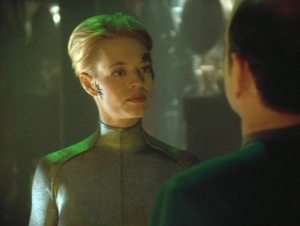
After striking a tenuous alliance with the Borg to defeat a common enemy, our wayward crew finds itself playing host to Seven of Nine, a member of the Borg whose connection to the Collective has been severed for the standard techno-magical reasons. A few other Borg henchmen are unceremoniously dispatched from Voyager after they betray the crew’s trust, leaving Seven of Nine to advocate for itself. (It should be noted here that the Voyager crew think of Seven of Nine as female, although at this point the Borg probably considers such gendered designations Irrelevant.) The crew digs into their effective captive’s history, discovering that Seven of Nine was once a little girl who was abducted and assimilated by the Borg. At that point, Captain Janeway makes it her mission to bring Seven of Nine back into humanity’s fold.

7 of 9 borg

Seven of Nine, badass Borg

This is not the first time Janeway’s leadership has made me uncomfortable. I’m not sure I’d follow her home, especially if the option of joining Holo(hottie)-Chakotay in his coup were to worm its way out of its interactive fictional exercise and into reality. The point is, Seven of Nine wants to return to the Collective, or, barring that, be dropped onto the nearest hospitable world. Both of these requests are denied, as is her more basic request to maintain her personal (or species?) agency.

A crucial aspect of “The Gift’s” plot revolves around the ethical question of whether to return Seven of Nine to her original human state. Because she is no longer connected to other Borg, the Doctor determines that the human parts of her body are rejecting the Borg technology. Captain Janeway seizes upon Seven of Nine’s biological history as proof positive that she is fundamentally human and must, deep down, wish to become so again biologically. Janeway denies Seven of Nine the choice of whether to undergo what amounts to both major invasive surgery and a change in biological identity, instead claiming this as her prerogative, citing Noble Human Reasons.

In doing so, Janeway denies the Borg as a species the dignity of personal agency. And since what little humanity is left within Seven of Nine doesn’t readily (or recognizably) asset itself, Janeway takes it upon herself to speak on its behalf and give it more weight than the (very loud) assertions of the Borg part of Seven of Nine. Thus Janeway leverages her power as captain to declare Seven of Nine’s Borg identity invalid, clinging to the idea that what was once human must still be fundamentally so. She orders the Doctor to medically extract and enhance Seven of Nine’s available human biology, enabling it to completely eject her Borg DNA and technology. The Doctor, for his part, enables Janeway, and Seven of Nine is forced to become human against her will through a process that amounts to medical torture.

Why the Doctor doesn’t invoke his Hippocratic oath, as he did when Tuvix expressed his desire not to die (season 2, episode 24), is a major unanswered question. The Tuvix episode did a much better job of representing the complexity of the ethical dilemma at hand. There’s little such nuance here. Viewers are made aware of the opposing arguments [read: Seven of Nine’s position about her own body] only so they can be shut down by the characters who occupy the positions of power in the Federation hierarchy and along the moral axis of the cast.

One of the most maddening weaknesses of Star Trek‘s otherwise inclusive philosophy is its insistence that humanity is the pinnacle of existence. The episode is SO SURE of Janeway’s moral high-ground that it’s disturbing, which points to Star Trek‘s occasional failure to achieve the progressiveness it prides itself on espousing. Janeway’s position amounts to one of human species supremacy, echoing centuries of colonial white supremacy, and she imposes it on a being who is already in a disadvantaged position and has little recourse. Janeways repeatedly ignores Seven of Nine’s clearly stated desires and staunch refusals to grant consent. But in a heartbreaking irony, resistance for this Borg is indeed futile.

7 of 9 human

Seven of Nine, reluctant human

Once again, the female body is stripped of its agency and remade into society’s image. This time literally. Viewers are meant to side with Janeway’s view of the situation and cheer when humanity triumphs and they are able to count Seven of Nine (see what I did there?) as one of their own.

Perhaps contemporary discourse surrounding consent and identity politics is what’s causing me to react so negatively to this plot and character developments. I don’t doubt that the episode’s moral stance was better received when it aired in 1997. But today, these blatant denials of someone’s personal agency simply do not fly (puns are always intended).

In the Delta Quadrant, the perception of humanity eclipses even the Prime Directive.

3 Comments

Filed under Beginning of the Body, Gender Trouble, Power, Television and Movies

Poetic Interlude: Special Announcement

I’m thrilled to announce that my first published poem, “Tract Home Take Down” has found a home in the debut issue of Angels Flight • literary west, a new magazine dedicated to celebrating the complex realities of Los Angeles and the artists who live and work here.

Leave a comment

Filed under Contemporary, Meta, Nostalgia, Power, Racism, Wordplay

An Open Letter to Young Women at Their First Swing Dance

*Trigger Warning: This post discusses sexual harassment and assault.*


[Edited 12/11/15–see addendum at the end]

Welcome!

On behalf of the swing community, let me first say that we’re so glad you’re here! I hope you have such a good time that you come back every single week. You make our dance community richer.

You’re going to learn a few basic steps, enough to get you out on the floor and moving to the music. Your teachers will get started in a few minutes, but first I wanted to talk about what to expect in this social situation, and remind you of your rights as a person.

Your instructors will probably encourage you to accept (enthusiastically, even) every offer to dance, especially if the offer comes from one of your fellow classmates. If you feel this enthusiasm, by all means, accept! Dance! Have fun! Make mistakes! Laugh at them! Try not to step on anyone! Apologize if you do! Just be your awesome self!

But–and this is very important–I want to make sure you also feel good about declining offers. Especially if you feel uncomfortable.
Too often girls and women are expected to smile and be demure, to put up and shut up, all while feeling as though they’d rather be anywhere else. Let’s not repeat this pattern that makes it easier for people–mostly men–to take advantage of us.


Tonight I’m encouraging you to assert your right to be in this space as a full person, a person with bodily autonomy.


It took me a decade to get to this place of asserting my right to a safe space, and I still slide back into harmful, enabling habits from time to time. I’ll sometimes eschew the directness I know is needed if men are going to learn that their advances are not always welcome. I’m trying, with this letter, to save you a decade of self-doubt and personal violations.


Too often, we teach new female dancers to be coy in their refusals, to say we’re “taking a break,” or “going to get a drink of water” in the name of politeness. But this places the burden, as usual, on women to coddle the fragile male ego. Enough. We’re only making things uncomfortable and unsafe for ourselves and the next generation of female dancers.


You’re probably going to be approached by a few older men tonight. They will ask you to dance. Most of them will be great people. But one or more of them might make you uncomfortable. I’m here to remind you to trust your discomfort and act accordingly. You do not “owe” anyone a dance. You have the right to say “no” firmly for any reason. Asserting yourself isn’t rude, it’s your right as a person. Don’t let the social expectation of female politeness bully you into saying “yes” to a situation that you think will make you uncomfortable.


It’s not about the intent of the person who is making you feel uncomfortable. Don’t even go there. That’s what predators want–room to get in your head and create space for thoughts like, “he probably doesn’t mean anything by it…” Nope. Trust your gut. Listen to yourself. Assert your boundaries, and brush off any douche-bag who tries to guilt-trip you about having or setting them.


You are under no obligation to make someone else feel welcome at the expense of your personal safety. You have as much right to this space as anyone else; as much right to your body as any other individual has to theirs. You are not obligated to feel flattered that someone is asking you to dance. You are never obligated to say “yes.”


The men who make you feel uncomfortable are counting on your also feeling too intimidated to stand up for yourself. They are counting on your ignorance of their MO. How could you possibly know that these men consistently target the newest, youngest, most inexperienced dancers in the room? (Welcome to the dance-floor power dynamics.)


These men will position themselves as benevolent, more experienced dancers who are doing you a favor. They expect you to be flattered, or at least taken back enough that the politeness you’ve been socialized to respond with kicks in over any inner hesitations.


These warnings and suggestions should not be taken as an indictment of older men as a category. You can (and should, when you want to) dance with people of all ages and experience levels–there’s fun to be had all around! This is not about advocating for snobbery. This is about remaining in tune with your comfort level, and respecting your very real feelings of discomfort. Predators are counting on you to dismiss your feelings in favor of abiding by social expectation. They look for girls who are young and shy and unsure of dance floor etiquette. They look for girls and women who have internalized the gendered social role of submissive politeness.


It’s time to call bullshit on that dynamic. All it does it take power away from us and hand it to another person.


For too long we’ve let lecherous older men prey on the young women who come here to have a good time, intimidating them into close contact and taking advantage of their naiveté. They hold women too close, they make suggestive conversation, they touch women inappropriately. This often drives women away, which weakens the dance scene and indirectly perpetuates this predatory behavior.


Don’t get me wrong; consensual inter-generational dancing is awesome! Making friends with people of all ages and ability-levels is part of the magic that is this community. All I’m encouraging you to be aware of are your personal boundaries, and to reject the burden of the cultural expectation that says women must make men feel welcome at all times. You have friends here. We’ll back you up. Women stay silent about this type of harassment for many reasons, one of which is fear that speaking up will backfire. The knowledge that our credibility may immediately be called into question, or that we’ll be accused of being “too sensitive.”


Well, that’s not this community.


Earlier this year, a woman came forward to share her experience of being sexually assaulted by an older dancer. Other female dancers soon confirmed his predatory behavior by sharing their own experiences. The most common response to their stories? “I believe you.” Prominent dancers in the community spoke out in support of these brave women, and serious discussions took place both online and at dance venues around the country. We all had to process what this meant for the community, and are committed to creating safer spaces for dancers, spaces that don’t create opportunities for predators.


So please remember that you get to say “no” at any time, not just to the initial ask for a dance. If you say yes initially and get out on the dance floor and start feeling uncomfortable with your partner, you can and should walk away from the situation.


You have as much right to be here as anyone, and that means feeling safe and in control of your body.


So let’s practice saying these perfectly acceptable phrases:


“No.”
“No thank you.”
“You’re making me uncomfortable.”
“This dance is over.”


The more we assert ourselves in this clear, direct way, the more normal it will become.


Let’s make the dance floor a safer space for everyone. We deserve it.

Addendum: Several swing dancers have rightly pointed out that predatory behavior is not found solely among older men. The older-man/younger-woman dynamic is the most visible example of predatory behavior, and that is why I focused on it. But this power dynamic is by no means the only context within which abuse can occur. Unfortunately, people of all ages have been known to violate others’ boundaries.

There are many other things that must be done to make social dancing a safer space, chief among them educating men about appropriate behavior early and often. The point of this particular letter was to empower dancers who identify as female to trust themselves and refuse to engage with people who make them uncomfortable. I’m hoping that more dancers will feel comfortable paying attention to, respecting, and maintaining their comfort level. This includes enlisting the support of fellow dancers and venue organizers when their boundaries are not respected — whoever the offender might be. The burden is on all of us to make this an easier thing to do.


Cross-posted to Medium.

6 Comments

Filed under Contemporary, Gender Trouble, Power