Theme Parks and You: How to Consume Efficiently and Be Your Own Advertisement

As I stumbled around in 100 degree heat toward the next ride, futilely adding another layer of sunscreen to my saturated-yet-sun-dried skin, I was struck by an idea that doubtlessly countless others have had before*:

Amusement parks are a study in infinitely fractal, self-referential marketing and cross-promotion. Our presence as the willing public is their greatest opportunity, for we are a captive audience. Captives who have paid to be trapped in an endless barrage of merchandising. (A barrage made up of attempts clever, clumsy, and blatant alike. Often within what could be isolated as a single “pitch.”) It really is extraordinary (and also perhaps expected or mundane, which itself says a lot about our culture) the different levels on which this marketing happens.

The imitated voice of a famous rabbit Muzaks its way into our somewhat offended ears, telling us that now is the perfect time to upgrade to a season pass…so we can come back and keep hearing him give us these little tips and spend more time awash in a sea of themed advertising. Stores sell all sorts of products with the park’s logo on it, characters that the park is affiliated with, merchandise with the names of various rides, comic book character capes: everything you could ever want and very little you “need.” The rides are named after current, recent, or upcoming movies, reminding the public to go see them and be part of the national summer blockbuster conversation.

Perhaps this isn’t as extraordinary or complex as all that, and others have analyzed this phenomenon in more depth and with more care**, but when you start pulling back the layers, it certainly seems to be. Even while entering and exiting rides, patrons are reminded to go eat a turkey leg at a nearby snack bar, or visit a different ride or attraction. Everything is designed to remind the visitor about different aspects of the theme park’s financial interests so that they can support these interests by buying commodities that have been fetishized nearly beyond recognition and functionality.

Is that post-modern punk kid wearing that super-hero cape ironically, or seriously, or because it struck him as the appropriate thing to don while experiencing the corresponding ride? Are we playing these carnival games because we like that it involves hitting a representation of that pesky cat who always tried to kill the bird on the Saturday mornings of our youth, or because it involves the chance of winning an oversized plush doll that represents an entirely different cartoon character? Are we just pawns in several large, incestuous companies’ schemes to make sartorial advertisements out of us–soon all we’ll have to do is look in the mirror, and our shirts will subconsciously remind us that we really do need to go see that new super-hero movie. And then go buy a ticket and pay for parking so we can go ride the ride, and then buy a pen or hat or coffee mug to commemorate all of this.

Maybe none of this matters. It is what we’re paying for, after all.

Thoughts? Further unpacking? Anyone want to call “shenanigans”?

——————

Notes:

*Therefore, all of this could, indeed, be a product of sun-stroke.
**See, for example, a discussion of Disneyland in Postmodernism: a reader by Thomas Docherty; Satisfaction Guaranteed by Susan Strasser; Inside the Mouse: Work and Play at Disney World by Jane Kuenz; and Advertising the American Dream by Rolland Marchand.

3 Comments

Filed under Commodification, Contemporary

Meta-Topic: Animals

Perhaps this should have been posted from the get-go. Come to think of it, there should have been a little series of these “what-to-expect-categorically” posts, in order to orient the focus of this blog. But whatever. It’s happening now.

One of the main topics this blog explores (or will come to explore in more depth as it continues) is that of non-human animals in culture. This is broad, obviously, so it might be good to lay out in general terms what posts under this category might deal with in the future. The theoretical orientations and analytic tendencies will be mainly anthropological, and a little radical in cases where I become un-tethered to scholarly moorings. (Yes, we’re doing nautical metaphors, now. Animals can go on ships, too. Just roll with those waves and sail on.)

People incorporate other animals into their lives to different degrees in various ways. So too, cultures as a whole. This happens on different levels, such as discursive, physical interaction, and broad mental categorizations that can become verbally rationalized when the topic comes up. I hope to have several different series in the future that use non-human animals as their center to explore various culture issues–as well as topics that focus on animal-human relationships specifically. Indeed, there are many avenues to explore, and I just hope these forays into fauna will be as interesting for readers as they are for this writer to think about.

One can explore the tendency to personify or give human qualities to nonhuman animals–especially for use in allegories and literature in general. But this also happens everyday when people talk about animals. Or talk for them.

Another main topic I’d like to explore as this blog continues is the ways in which consumer culture uses various animals to sell things. Closely related is the use of animal imagery or culturally constructed characteristics identified with certain nonhuman animals and how they are used to signify various things. Semiotics for everyone!

Nonhuman animals can be implicated in political discourse, used to embody gender norms, symbolize anything you can think of, and deployed as terms of abuse (thank you, Edmund Leach). They are everywhere and nowhere, and we can even look at issues of agency (see the last post and a particularly good comment from the author of Instruct/Deconstruct). They are differentially valued, thought about, and interacted with based on a complex system of categories enacted daily in cultural practice, and no one animal means the same thing in two situations, for two people, in two cultures. I could go on about this for days, so perhaps I should just end by saying that if you like thinking about animals, stay tuned…

1 Comment

Filed under Animals, Meta

Beef So Fresh It’s a Cash Cow

Turning life into food isn't free

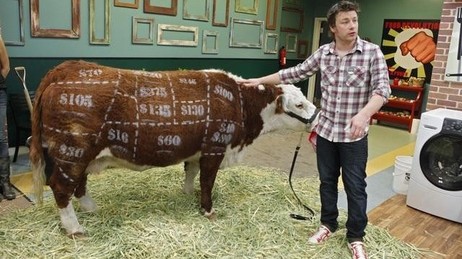
First, a disclaimer–this is neither well-thought out nor well written. Also, here is the NPR article that goes with this picture. Photo credit is Greg Zabilski/ABC. Now to the somewhat predictable spin-off rant:

The host of this show (human pictured above) apparently wants people to think about what they are eating. And to think about it as a good American consumer would: in terms of how much it costs. This is veiled in the guise of encouraging more healthy eating (does cheaper automatically equal less healthy?). I’m not criticizing his project as a whole, just pointing to a few implications it has, or, more accurately, the delicious implications of the image above. (I’m also not criticizing the NPR story, which is focused on different issues and is worth reading for itself, especially if you want to know more about the TV show that this image is from.)

I frequently (some might say obsessively) use bovines to explore a lot of cultural issues, and this image and its accompanying article smacks you in the face with a few of them: animals-as-food, commodification of life, and placing monetary value on the spoils of death, to name a few. This cow is being used as a powerful device to illustrate to people how much they are paying for which cuts of meat. It is powerful, for one reason, because the connection between the live animal and its edible products are normally not illustrated so graphically. Cash value has been physically inscribed on a live animal that will, ostensibly, be killed and eaten. This cow stands for the idea of nutritional value for one’s money, and stands for all the beef that Americans consume. (I do wonder if the show at all addresses how value is added to cattle and the various cuts of meat they become…and this reminds me that I should really re-read and do a book review of Shukin’s Animal Capital.)

Honestly, I just love how blatantly monetary value is inscribed on this animal–it becomes a thing, a commodity, right before our eyes, even as it continues to embody movements that might be construed as independent and life-like. But this animals isn’t given a subjectivity of its own. Rather, it is made an object of education; a symbol of itself as a heavily used commodity in the U.S., of American eating and spending habits, of many things, just in this one image. The human next to it uses the animal and makes it mean certain things for his audience; lays his hand on its shoulder as if its body were a blackboard–as, indeed, it has been visually manipulated to become. It is on a leash, and at any moment the man can pick up the other end and have this mobile blackboard tethered to him–the man is in control of this might-as-well-be-dinner educational tool. (Unrelated note: wtf is with the washing machine in the right-hand corner?) This animal is marked for consumption–both as a commodity and as an eventual collection of differentially priced food items.

I just find this all very interesting, is all, and when I come across images such as this one which so clearly capture America’s relationship with food animals and consumerism, I squeal a little inside and have to share it. Mmm…semiotics!

4 Comments

Filed under Beginning of the Body, Bovinity Infinity, Commodification, Contemporary, Media, Television and Movies

A Fragment: Practice Makes Meaning(?)

I had this half-baked thought back in March, when I read the headline of a news story about the possible impending government shut-down in the U.S. It’s sort of still relevant, topically, and the argument I jump to from the topic is almost always relevant, so here we go:

In the news story, the possibility of the (then) current government shut-down was automatically compared to that of 1996. Maybe this is a valid parallel, but it might not be. The contexts of the shut-downs, the possible causes, will necessarily be very different. They are located in different socio-historical moments, after all. But in mass-mediated news, even publicly-funded news outlets, those contextual details get lost in favor of familiar narratives and neatly packaged parallels. And then future historical narrative–as presented by the media, at least, and perhaps high school text books, will remember the parallel and constructed similarities of the incidents, if it remembers these two incidents at all. (Maybe they won’t–maybe they’ll stress the differences. I can’t predict the future. But the two incidents will, in all likelihood, be compared and packaged together in some way. The will reference one another and thus imply similarity.)

The larger point is that, regardless of context, political discourse and the way in which it is structured, both internally and as a genre with all its connections and within the wider culture–and importantly, the ways in which it is mediated to various segments of society (pundits, the public, the politicians themselves, etc)–makes these instances meaningful. In this case, the mediated political discourse makes the parallel a talking point, maybe even an accepted truth, because of the way that political discourse and the media frame events–stripping them of context to make that neat parallel. (This argument just got dangerously circular, but hopefully it’ll pull out.)

Other types of narrative and rhetorical tricks and performatives exist as well, parallelism is just one of them. One easily understood and accepted by the masses, perhaps because it is so often relied upon to make the news familiar and digestible. To make the masses return to particular outlets for their updates, to make students remember things in history classes. Familiar narrative structures win over the unexpected and un-categorizable. The latter is just an unexplainable horror until it can be narratively stretched and twisted until it fits into a safely shaped box.

Anyway, one point I want to return to is that use makes meaning. Saying it and repeating it makes something true: political discourse and historical narratives like patterns. Patterns are safe. And the patterns become reality. The idea that meaning comes from use is a tired argument, itself, and the basis for a lot of anthropology, but it seems to hold up when confronted with fieldwork data. (But perhaps we anthros are just making that fit into our own familiar, underlying-premise box. Disciplinary existential crisis warning!) Back to the topic that started this whole fragmented musing, reporting things makes them relevant to the debate; to the voters; to the election. The media and the pundits do have power: they have the power to shape the debate. And on a larger scale, the historians have the power to shape the grand narrative. Not sure exactly the ways in which those two entities are related, but they are…maybe someone else has the energy to unpack that messy box.
Returning to the potentially obvious conclusion, meaning comes from use, and performativity. Practice proves it. Maybe.

3 Comments

Filed under Contemporary, Media

We interrupt this hiatus to bring you an international moment of bovinity

While on the bus from London to Cardiff, I was taken with the many drizzle-drenched fields and forests, the grazing sheep and frolicking lambs along the way. But something gave me pause and a rush of childish excitement.

I saw a purple cow.

Don’t try to tell me it was just a horse in a poncho–I KNOW WHAT I SAW!!!

4 Comments

Filed under Bovinity Infinity, Contemporary