
but it’s worth checking out:
blissblog on culturesourcing, local to global, and its implications
but it’s worth checking out:
blissblog on culturesourcing, local to global, and its implications
Filed under Check This Out!

"New"
Orchard Supply Hardware got itself a new logo and is now calling itself “Orchard” or “Orchard Supply,” depending on the version of the sign on the actual store fronts. In contrast, here is how the company’s stores used to announce themselves:

Old
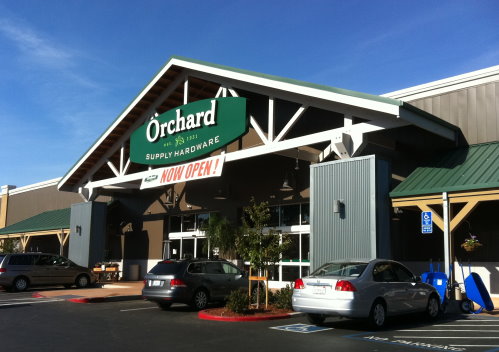
The newly-logo-ed sign captured in the wilds of an American shopping center.
I think this logo-change is a product, or symptom, of how mainstream the “green” and “organic” movements have become. These are no longer fringe ideas and lifestyles: a great number of “mainstream” Americans of the class that can afford to shop at Orchard, I’d venture, consider themselves sympathetic to these concerns and inclined to buy organic everything-they-can. The dissent of these intertwined movements has officially been commodified* to the extent that it’s mundane and expected that people are living “green” lives. Now, marketers have decided/realized that the majority of potential consumers associate positive things with “nature.” With “traditional” farming. Even the font nee’-OSH has switched to bespeaks a kind of small-towny, family farm type-face used on crates of apples and the like.
This new logo relies on a chain of associations that consumers are expected to make upon seeing the sign. In no particular order, here are a few that came to this consumer’s mind upon first seeing the new logo: orchard-apples-farming-organic food-green living-old timey letters-Americana-main street-small towns-family farms-barn dance-fresh cut wood…the new sign is a veritable red-and-white-stripped jacket, cane-carrying, straw-hat clad carnival barker:
All this good nostalgic stuff can be found HERE, folks! Come inside and get in touch with your American roots. We sell no real food, but we DO have mulch and stuff that can grow it. And light-bulbs and ladders and–Uh…organic! Just look at the sign. Reminds you of rows of trees, doesn’t it? See, we here at Orchard are in touch with your idealistic lifestyle. Come here to turn these ideals into a reality!
Yeah, right. Does anyone else ever get tired of living in such a sham of a world?
——–
*See “Why Johnny Can’t Dissent” by Thomas Frank. 1997. The Baffler Literary Magazine.
Filed under Commodification, Contemporary
Why is it one of the most predictable exchanges or conversations when dining in a restaurant goes something like this:
Diner 1: How’s your fish?
Diner 2: Not bad. A little dry.
Any food item and judgement thereof can be substituted, and the effect is the same: we ask about the quality of the food our companions are eating as if we’ve had anything to do with its preparation. As if we are somehow invested in how it has turned out, and our fellow diner’s relative enjoyment of it. (We might be monetarily, but the question of how the food is bespeaks a more producer-ist underlying concern on the part of the asker. And this is why such conversations struck me as odd.)
To contrast, rarely is such an honest review of a meal given in someone’s home, where the host or a family member has prepared it. It would be rude to say that your friend’s fish were dry. But somehow, in a restaurant, where presumably the cook cannot hear (although the wait staff certainly might) it is perfectly acceptable to be blunt. The spatial separation is key, here, in avoiding the rudeness label for such an exchange. That and the fact that the cook in a restaurant is a stranger with whom diners have no social relationship, while the cook in a home is.
Discussing food quality and the enjoyment of a meal with honesty is only acceptable in certain contexts. Contexts in which there is spatial and social separation between the cooker and the eater. So, basically, you can be honest about how well or little you like your food in the public sphere. In the private sphere, being honest (unless it’s positive honesty) is a faux pas; a snub at the edible gift.
It should be pointed about that dishonesty usually occurs in restaurants when the asker is the payer and the answerer is the receiver of the gift of the dinner. In this case, the asker of the “how’s your meal?” question is seen as having a vested interest in–and of having contributed to–the quality of the eater’s experience. To speak ill of the food that someone else has paid to put in your mouth would be to metonymically insult them via their gift. (But in most casual restaurant contexts, this does not apply. Diners feel free to speak ill of the food regardless of who’s fronting the money for it.)
All this is to say: how weird is it that we do not think about the feelings of the nameless cook in a restaurant as we bash their work and what they have made, but lie our asses off about the food a friend or relative or host has prepared? Upon deconstruction, it kind of makes sense, but it’s still odd. (And I really hope our waitress didn’t tell the cooks that I said their soup was salty and the cheese-bread smelled like chlorine.)
Filed under Contemporary

Bam: AnthroMeme.
Occasionally a celebrity will die, or an old commercial tune will come on, or one person will mention a public figure also known to another person of the same generation. These types of scenarios often spark a collective nostalgia performance. And, if there is someone younger about who shows the least bit of curiosity (“who was that?“), or even if they show none, there will most likely be a history telling of this pop-culturally significant nostalgia. “Well, so-and-so was a well-known [insert occupation here] in the late 19[??]s who really [contribution to (pop) culture]…”
Most often I experience this around my older relatives, removed by a generation, sometimes only by half a generation, if it’s a cousin who’s significantly older. This is different from sharing different subcultural knowledge. No, this has a historical element. This type of sharing and telling is bolstered by its nostalgia; by its being in the past and no longer being relevant (or present/visible) in the present cultural moment. This is about reliving the pop-culture the experiencer and teller has found important–and that past society has told them is important.
This is pop-culture canonization. Telling about those people and phenomena remembered as significant. Popular culture canonized in peoples’ memories and collected sharings of them as history. As truth about the past. This person I remember that you young’uns don’t was important, and let me tell you why. (Because I can state some facts about them. Because the media told me they were important once. Because I remember seeing them on TV, hearing that jingle, reading about them in the paper, hearing my parents talk about them…)
Filed under Contemporary, Historical, Media, Nostalgia



 Contemporary Contempt
