Tag Archives: meaning

Sartorial Bovinity: Quick, What’s the Opposite of a Monkey Suit?

Hospital of Make Believe: Bear and Monkey Expected to Make Full Recovery

These stuffed toys grace the display area of a non-profit that deals in durable medical equipment. They demonstrate the friendly, benign nature of a standard hospital bed, serving to cheer up the often more grim realities associated with such equipment. The monkey, especially, adds a note of whimsy by being dressed up as a cow. There is a (small?) trend in the world of stuffed toys to dress one animal species in the “suit” of another. This is generally received to be “cute,” but one wonders what other meanings and implications such sartorial animality has.

Perhaps it is cute because it is odd…odd to see one type of the general category of “animal” pretending to be another type. When humans pretend to be other animals, there is a different reaction, although perhaps I should compare this with humanoid dolls in animal “clothing.” In which case, it is seen to be cute, as well. My point was going to be that humans in Western culture see themselves as set apart from the general category of “animal,” which lumps together all others. It is just difficult to trace out the various categorical intersections, interstices, and radical separations without delving into extreme fieldwork that involves thousands of participants. So I will leave it at this:

What do you think of the monkey above, of animals pretending to be other animals, and of representations of animals (especially those used in play) being dressed up as other animals? And finally, is the other animal necessarily also Other?

Leave a comment

Filed under Animals, Bovinity Infinity, Contemporary

Mundane Matters

There is great value in studying the quotidian (as my archaeologically-inclined colleagues would say). The mundane is the nitty-gritty of culture: where it all happens. Where the pop gets transformed into the everyday, and where the everyday asserts itself as a force separate from the pop. It is in everyday practice that culture occurs; not just the mass-mediated, the recorded, the great-man sweeping narratives. No. You are making history, are engaging with culture, and creating and being and becoming. We are all engaged in an ever-evolving, dialogic process of meaning-making.

This post ends now, before the New Age hippy-dippy swallows the more practiced academic tendencies and trips out on the groovy similarities.

Leave a comment

Filed under Contemporary, Historical, Meta

Art, Deviance, and the American Imagination

It was someone’s off-handed description of something as “very noir” that got me on a haphazard brain-storm about deviant behavior and where we Americans tend to compartmentalize it and allow for it in our culture. Those compartments seem to be art and humor (and verbal abuse, with thanks always to E. Leach). (We’re not going to deal with outright derision, just those phenomena that index deviant behavior’s status as deviant from the socially mandated norm.)

It seems as though an awful lot of art–literature, music, visual art, movies, etc–is devoted to topics that showcase deviance. Deviance means interest–it’s almost an obsession. Film noir, which takes ordinary people and places them into seedy situations with the criminal underground, is one obvious example. Or any contemporary action movie or thriller, which generally involves a protagonist navigating some odd subculture or two while avoiding the “bad guys” and trying to solve some conspiracy, well-plotted or otherwise. There are more books about the extraordinary, the strange, the wrong, than the mundane and good. We love being voyeurs of that-which-is-not-officially-condoned. As members of the socially responsible majority, we cannot help but be fascinated with these alien underbellies that we would not dare participate in other than through the consumption of art.

The deviant Other is indeed in the savage slot. We imagine it as so close, yet completely removed from our own lived experiences, and we indulge our imaginations with graphic depictions of what these Others must be like. These anti-social savages with their disregard for social norms. We make joking, disparaging references to them in daily discourse–perhaps slyly comparing a similarly mainstream compatriot to a deviant Other of choice. And it is in the joking that we call attention to the fact that these Others are in fact deviant. It is in the joking that we signal our simultaneous fascination and discomfort.

Perhaps this is a vestige of puritanical culture-policing (because why not make tenuous discursive connections to that historical narrative?). Because deviance is not condoned in polite, everyday society, we have outlets for it; outlets that are clearly marked as not real; just art. (Art, of course, is real and a cultural product, but art that has deviance as a subject is often marked as deviant itself, depending on how puritanical or Victorian the climate is at any given time.) Such deviant art is both a reaction against and a validation of the existence of social-control strictures that we all embody and internalize, albeit not always consciously. Hegemony is everywhere and nowhere, man. We are all participants in the mass indoctrination and the mass-creation of our culture and its social norms. Deviant art is partially an acknowledgment of this, and also a place to let those normal among us experience–or look at or talk about–what we are not strictly supposed to experience. Art and jokes as outlet, as compartmentalization, as keeping-safe, as drawing boundaries between that which we condone, and that which we do not but enjoy by proxy. There will always be spaces for hedonism, even if they are explicitly marked as such, and bad to boot.

Leave a comment

Filed under Art of all Kinds, Contemporary, Historical

Meta-Topic: Animals

Perhaps this should have been posted from the get-go. Come to think of it, there should have been a little series of these “what-to-expect-categorically” posts, in order to orient the focus of this blog. But whatever. It’s happening now.

One of the main topics this blog explores (or will come to explore in more depth as it continues) is that of non-human animals in culture. This is broad, obviously, so it might be good to lay out in general terms what posts under this category might deal with in the future. The theoretical orientations and analytic tendencies will be mainly anthropological, and a little radical in cases where I become un-tethered to scholarly moorings. (Yes, we’re doing nautical metaphors, now. Animals can go on ships, too. Just roll with those waves and sail on.)

People incorporate other animals into their lives to different degrees in various ways. So too, cultures as a whole. This happens on different levels, such as discursive, physical interaction, and broad mental categorizations that can become verbally rationalized when the topic comes up. I hope to have several different series in the future that use non-human animals as their center to explore various culture issues–as well as topics that focus on animal-human relationships specifically. Indeed, there are many avenues to explore, and I just hope these forays into fauna will be as interesting for readers as they are for this writer to think about.

One can explore the tendency to personify or give human qualities to nonhuman animals–especially for use in allegories and literature in general. But this also happens everyday when people talk about animals. Or talk for them.

Another main topic I’d like to explore as this blog continues is the ways in which consumer culture uses various animals to sell things. Closely related is the use of animal imagery or culturally constructed characteristics identified with certain nonhuman animals and how they are used to signify various things. Semiotics for everyone!

Nonhuman animals can be implicated in political discourse, used to embody gender norms, symbolize anything you can think of, and deployed as terms of abuse (thank you, Edmund Leach). They are everywhere and nowhere, and we can even look at issues of agency (see the last post and a particularly good comment from the author of Instruct/Deconstruct). They are differentially valued, thought about, and interacted with based on a complex system of categories enacted daily in cultural practice, and no one animal means the same thing in two situations, for two people, in two cultures. I could go on about this for days, so perhaps I should just end by saying that if you like thinking about animals, stay tuned…

1 Comment

Filed under Animals, Meta

Beef So Fresh It’s a Cash Cow

Turning life into food isn't free

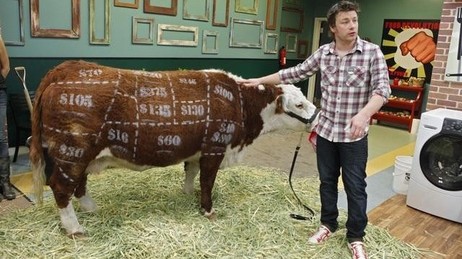
First, a disclaimer–this is neither well-thought out nor well written. Also, here is the NPR article that goes with this picture. Photo credit is Greg Zabilski/ABC. Now to the somewhat predictable spin-off rant:

The host of this show (human pictured above) apparently wants people to think about what they are eating. And to think about it as a good American consumer would: in terms of how much it costs. This is veiled in the guise of encouraging more healthy eating (does cheaper automatically equal less healthy?). I’m not criticizing his project as a whole, just pointing to a few implications it has, or, more accurately, the delicious implications of the image above. (I’m also not criticizing the NPR story, which is focused on different issues and is worth reading for itself, especially if you want to know more about the TV show that this image is from.)

I frequently (some might say obsessively) use bovines to explore a lot of cultural issues, and this image and its accompanying article smacks you in the face with a few of them: animals-as-food, commodification of life, and placing monetary value on the spoils of death, to name a few. This cow is being used as a powerful device to illustrate to people how much they are paying for which cuts of meat. It is powerful, for one reason, because the connection between the live animal and its edible products are normally not illustrated so graphically. Cash value has been physically inscribed on a live animal that will, ostensibly, be killed and eaten. This cow stands for the idea of nutritional value for one’s money, and stands for all the beef that Americans consume. (I do wonder if the show at all addresses how value is added to cattle and the various cuts of meat they become…and this reminds me that I should really re-read and do a book review of Shukin’s Animal Capital.)

Honestly, I just love how blatantly monetary value is inscribed on this animal–it becomes a thing, a commodity, right before our eyes, even as it continues to embody movements that might be construed as independent and life-like. But this animals isn’t given a subjectivity of its own. Rather, it is made an object of education; a symbol of itself as a heavily used commodity in the U.S., of American eating and spending habits, of many things, just in this one image. The human next to it uses the animal and makes it mean certain things for his audience; lays his hand on its shoulder as if its body were a blackboard–as, indeed, it has been visually manipulated to become. It is on a leash, and at any moment the man can pick up the other end and have this mobile blackboard tethered to him–the man is in control of this might-as-well-be-dinner educational tool. (Unrelated note: wtf is with the washing machine in the right-hand corner?) This animal is marked for consumption–both as a commodity and as an eventual collection of differentially priced food items.

I just find this all very interesting, is all, and when I come across images such as this one which so clearly capture America’s relationship with food animals and consumerism, I squeal a little inside and have to share it. Mmm…semiotics!

4 Comments

Filed under Beginning of the Body, Bovinity Infinity, Commodification, Contemporary, Media, Television and Movies